
Along any roof edge you will find three parts that look like one. Telling them apart helps you describe a fault, read a quote and understand what is being replaced.
On the long runs of terraces and semis in Ashley Down, the eaves are the first thing you see when you look up from the pavement. Fascias, soffits and guttering all sit together at that edge, and quotes often lump them into one line. Here is what each part does, and why they tend to need attention at the same time.
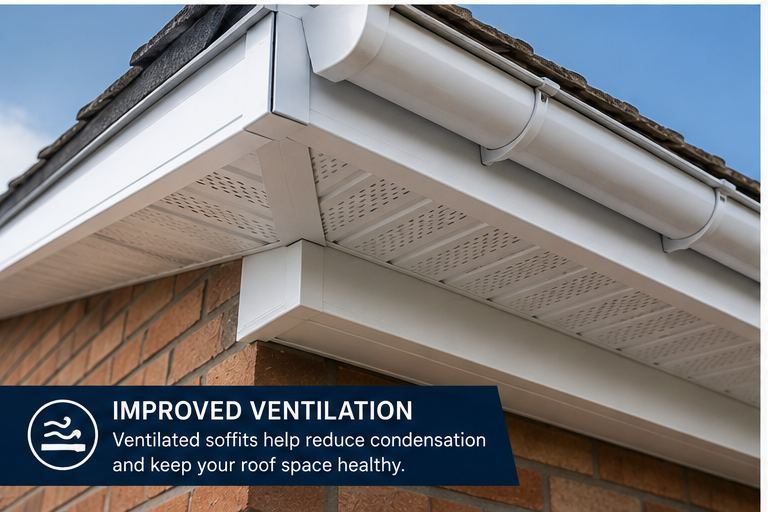
What the fascia does
The fascia is the vertical board running along the ends of the rafters, facing the street or garden. It holds the gutter in place and gives the roof edge a finished look. Because the gutter hangs from it, a fascia that has rotted or bowed will let the gutter sag, so a gutter problem often turns out to be a fascia one.
What the soffit does
Soffits are the boards on the underside of the eaves, which you see when you look straight up. They seal the gap between the wall and the roof edge, stopping birds, insects and weather getting in. When vented, they let air flow into the roof space, which helps keep timbers and insulation dry and reduces condensation.
What the gutter does
Guttering is the open channel that collects water running off the roof and leads it to the downpipes and drains. On terraces, runs can be long and shared, with several joints along the way. A gutter that overflows at the front may be blocked, tilted wrongly or leaking at a joint, and the water then soaks the boards and the wall below.
- Fascia: board carrying the gutter at the rafter ends
- Soffit: board closing the underside of the eaves
- Gutter: channel collecting and carrying rainwater
- Downpipe: vertical pipe leading water to the drain
Why they fail together
Water is the common enemy of every part of the roof edge. A leaking gutter soaks the fascia, a damp fascia lets water into the soffit and rafter ends, and a ruined soffit lets in pests and moisture. Bay roofs and rear extensions add short runs and corners where water collects, and shared terrace gutters add joints. Because of this, we look at all three whenever we are asked about one, and tell you which really need work.
Replacement and care
When replacing, the old boards and gutters come off, the rafter ends and eaves are checked, and new UPVC boards go on with vented soffits or vent strips. Gutters are refitted or renewed. UPVC is very low maintenance: wash it down rather than paint it. Where gable bargeboards need attention, we usually deal with them at the same time.
Frequently Asked Questions
Which of the three is most likely to need replacing first?
Gutters and timber fascias commonly give trouble first, as they are most exposed to water. Soffits tend to show problems later, often as staining, sagging or gaps that let birds and insects into the roof space.
Is the bargeboard the same as a fascia?
They do a similar job, but a bargeboard runs along the sloping gable edge, while a fascia runs along the horizontal eaves. On houses with gable ends both may need replacement, and we usually carry them out together.
Can I clean UPVC boards myself?
Yes, from the ground, with warm soapy water and a soft cloth or brush, which is all UPVC needs to look fresh again. Please do not climb or lean ladders against gutters to reach them. If they are out of reach, call us for a proper look and we will tell you what needs doing.
Talk to our team about UPVC fascias and soffits in Ashley Down
Every roof is different — the fastest way to get an accurate answer is a quick chat with our team.