
Replacing the boards along the eaves is more than swapping timber for plastic. It involves access, a look at what lies behind, ventilation and the guttering.
On a Victorian or Edwardian terrace in Ashley Down, the eaves run along the front and back of the house, often over bay roofs and rear extensions. Replacing fascias and soffits there is a methodical job done in a sequence. It is worth knowing the steps, so you can judge a quote and know what will happen on site.
Access comes first
The work is at the roof edge, so safe access is arranged before anything is removed. For a terrace that usually means scaffold or a tower, and we think through where it stands, how neighbours are affected, and where front-of-house pavements or rear gardens limit the space. This is arranged and explained in advance, not improvised on the day, and the scaffold stays until the gutters are back and tested.
Taking off the old boards and gutters
The gutters come off first, then the old fascia and soffit boards are carefully removed. On older homes we check what the existing soffit boards are made of before disturbing them, and handle them accordingly. Once the boards are off, the rafter ends and the eaves are exposed for the first time, and we can see what has really been going on behind them.
- Gutters taken down and set aside
- Old fascia and soffit boards removed
- Rafter ends and eaves inspected
- Any damp or decayed timber dealt with
Checking the eaves
This is the part owners rarely see. Water that has run behind a failing fascia can soak rafter ends, and birds and insects sometimes nest in the gap. We look for damp, decay and weak spots, and repair or strengthen as needed before closing it up. Skipping this step is how new boards end up fixed to timber that is already failing.
New boards and ventilation
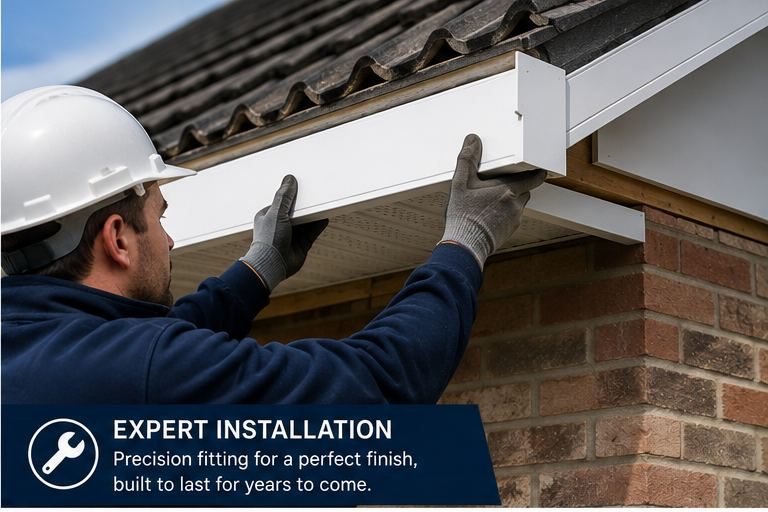
New UPVC fascias and soffits are cut and fixed to sound timber, with vented soffits or vent strips so the roof space can breathe. That helps prevent condensation in the loft. The boards are very low maintenance and cleaned rather than painted, in white, darker shades or wood-effect finishes. Bargeboards at gable ends can be dealt with in the same visit.
Gutters and finishing off
The gutters are refitted if sound, or replaced if worn, with the correct falls and sealed joints so water reaches the downpipes. We clear the site, check the work from the ground with you, and explain how to look after it. Some alterations may need planning or Building Regulations checks, and we advise before work starts. Before leaving we walk the line of the eaves with you.
Frequently Asked Questions
How long will the work disrupt my home?
It depends on the size of the house and the weather, and we give you a plan beforehand. Most of the disruption is outdoors, though the scaffold and noise can be noticeable for the duration, and we try to keep gates and paths clear.
Can fascias be replaced without new soffits?
It is possible, but the two are connected and share the same access. Replacing them together usually gives a neater result and lets us fit proper ventilation and check the eaves in one go.
Do the gutters have to come off?
Yes, in nearly every case, as they are fixed to the fascia. They are refitted afterwards, or replaced if they are cracked, sagging or leaking at the joints, and we tell you which is the case.
Talk to our team about UPVC fascias and soffits in Ashley Down
Every roof is different — the fastest way to get an accurate answer is a quick chat with our team.