
In most cases a dry verge can replace failed mortar on a roof that is already there. The checks are about the tile, the edge and the condition of the roof as a whole.
If mortar is dropping from the gable edge of a house in Ashley Down, a dry verge is often the sensible repair. Many semis and end-of-terrace houses have gables, and the edge is a recurring maintenance point that people often put off until it starts shedding. Before fitting one to an existing roof, we need to know whether the tiles, the timber under them and the wall suit the system.
Why retrofitting is possible
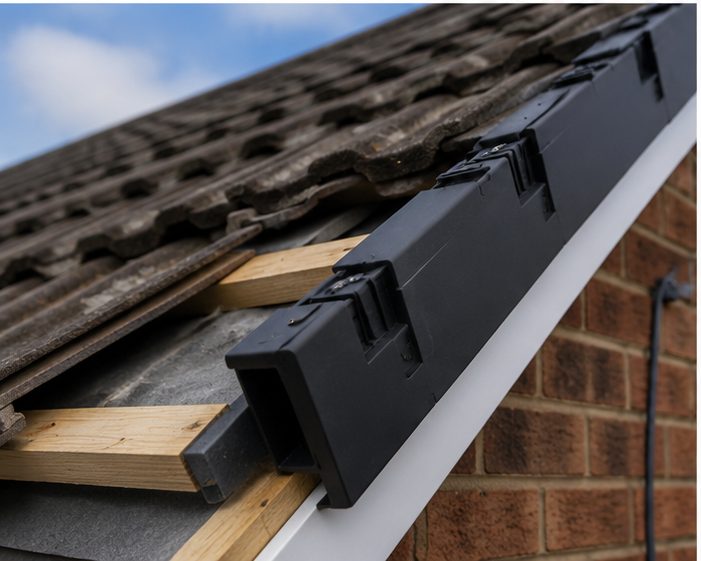
The dry verge only touches the roof edge. We clear out the failed mortar, lift loose end tiles, and fit the verge units and end pieces over the existing tiling. The rest of the roof stays as it is. That makes it a practical repair for houses where the main covering still has life in it but the gable edge has deteriorated.
The tile has to suit the system
Verge units are made for particular tile profiles. Plain tiles, interlocking tiles and slates need different parts, and old or mixed tiles may not be catered for. We identify the tile on site and fix to the tile maker's guidance. If there is no good match, we say so, and look at other ways of making the edge secure.
- Tile type, profile and thickness at the edge
- Whether tiles are original or mixed
- Existing overhang past the gable wall
- Condition of the battens underneath
Condition of the edge underneath
Failed mortar often means water has been getting in for some time. We look at the battens, felt and the top of the gable wall for dampness and decay. Rotten timber is replaced before the new system is fixed, and we show you what we found. A dry verge is only as secure as what holds it, so this preparation matters more than the visible finish.
When it is not the right answer
If the roof is failing across its whole area, a dry verge on the edge will not stop leaks elsewhere. We would repair or re-roof first, and fit the dry verge as part of that. A dry verge is not a cure for a roof failing elsewhere, and we say so plainly. Where the gable edge is badly damaged, extra work may be needed beforehand.
Signs to watch for from the ground
Mortar or small pieces of masonry on the path, drive or in the gutter beneath a gable is the typical first sign. You might also see gaps along the edge, birds entering under the end tiles, or tiles at the verge out of line. Please do not climb up to inspect it. Call us for a proper look and we will explain what is needed.
Frequently Asked Questions
Can only one gable be done?
Yes. Each gable is its own job. If one has failed and the other is sound, you can do just that one now and leave the other until later. Often both are done together because the same access serves each, but that is your choice.
Will the work damage my existing tiles?
We take care to lift only the tiles needed at the edge, and replace any that crack. Old tiles can be brittle, so the odd one may need replacing, which we tell you about in advance so there are no surprises.
Is the work noisy or messy?
Removing old mortar produces dust and some noise, but it is confined to the edge of the roof. We protect the ground below, keep paths and drives clear as far as we can, and remove all the waste when we finish.
Talk to our team about dry verge systems in Ashley Down
Every roof is different — the fastest way to get an accurate answer is a quick chat with our team.