
Water at a roof window is rarely the glass. It usually comes from the flashing, the seals, condensation or the roof covering around the frame.
A drip beside a roof window sends most people straight to the window, but the glass is seldom the culprit. On the steep, exposed roofs of Arnos Vale, wind-driven rain tests every joint around the frame. Finding the true cause means separating a leak from condensation, and looking at the flashing and covering as well as the window.
Is it a leak or condensation?
The first question is whether the water is coming from outside at all. Condensation forms when warm, moist air meets a cold surface, and it can run down the glass and the lining and look just like a leak. Poor ventilation, a cold frame or missing vapour control can all cause it. A leak, by contrast, tends to show after rain and stain the lining or ceiling around the edges.
The flashing around the frame
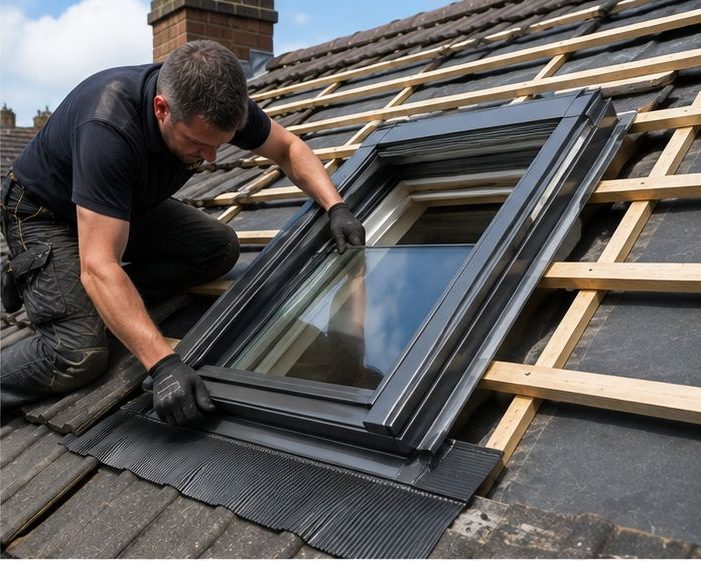
The flashing is the set of metal pieces that seals the gap between the window and the roof covering. It has to match the tile or slate, and it has to be fitted in the correct order so water runs over each piece. If a kit was wrong for the covering, or was disturbed or worn, rain can get behind it. This is the most common source of leaks at roof windows.
- Flashing kit not matched to the roof covering
- Gaps, lifted edges or damaged lead or aluminium
- Tiles or slates around the frame slipped or cracked
- Debris built up in the channel above the window
Seals, glass and misting
Over time rubber seals can harden or pull away and let water or draughts through. If you see mist or droplets trapped between the panes, the sealed glass unit has failed and needs replacing, though that is a different fault to a roof leak. Cracked glass or a damaged sash is more obvious. We look at each of these before blaming the roof.
The roof around the window
Sometimes the window is fine and the surrounding roof is not. A slipped tile or worn felt above the frame can send water down into the opening. Since water travels along timbers before it shows, the visible drip may be some distance from where it entered. We check the covering above and beside the window as part of tracing the leak, not as an afterthought.
What we do and what you can do
Indoors, check the lining, the ceiling and the loft side if you can do so safely, and note when it happens. Do not go onto the roof yourself. We then inspect outside, trace the cause, and repair or replace the flashing, seals or covering as needed. If the window is old and failing, we advise on replacing it with a new one matched to the roof, and explain what the lining and insulation will need.
Frequently Asked Questions
How can I tell condensation from a leak?
Condensation tends to appear on cold mornings, on glass and frame, with no link to rain. A leak shows after rain and often leaves staining. If you are unsure, note when the water appears, and we can tell you when we visit.
Can a flashing be replaced without replacing the window?
Usually yes. If the window is sound, the flashing and surrounding covering can be renewed around it. We take care with the lining and insulation so they are not disturbed more than necessary.
Is misting between the panes a roof problem?
No. It means the sealed unit has failed, and the glass or the whole window needs replacing. It does not mean rain is coming in, though it is worth having checked at the same time as any leak.
Talk to our team about VELUX and roof window installation in Arnos Vale
Every roof is different — the fastest way to get an accurate answer is a quick chat with our team.