
Many homes in Lawrence Weston started life as fairly standard twentieth-century council-built semis or low-rise blocks, and a good number have since gained a kitchen extension, a rear addition or a converted garage roof along the way. When a homeowner is planning a new roof, one of the first questions that comes up is whether the extension roof should be replaced in the same project as the main roof, or left alone for now and dealt with separately at a later date.
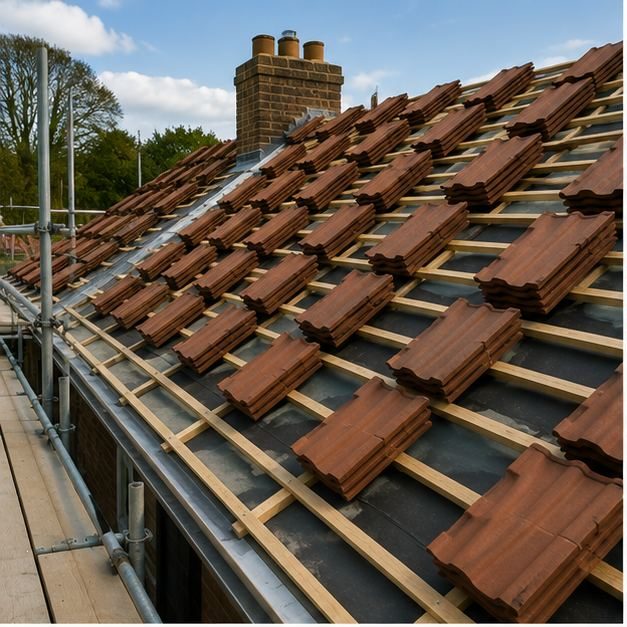
In most cases, doing both together makes practical sense. Once scaffolding is up and a roofing team is on site, extending the work to cover an attached extension adds relatively little to the overall project compared with bringing everyone back a few years later to do it separately, paying for a second set of scaffolding and a second mobilisation of labour and skips. It also means the junction where the two roofs meet, often the trickiest part of the whole job, can be rebuilt properly from both sides rather than being patched into an older covering that is nearing the end of its life anyway.
There are situations where it makes sense to treat the two roofs separately. If the extension is a genuinely recent addition with a roof covering still well within its expected lifespan, there is little point disturbing it just because the older main roof needs replacing. Flat-roofed extensions, which are common on rear additions in Lawrence Weston, are also a different job in material terms to a pitched tiled or slated main roof, and sometimes suit their own separate specification, timescale and even trade, since a flat roof covering such as a single-ply membrane behaves and ages quite differently to tiles or slates.
Cost is naturally part of this decision, but it is worth thinking about total cost over time rather than just the headline figure for one project. Replacing an extension roof a few years after the main roof can mean paying twice for access, once the true condition of both areas has been properly assessed rather than judged from ground level. There is also the question of disruption: a single, combined project means one period of scaffolding, noise and deliveries to plan around, rather than the household going through the process twice within a fairly short span of years.
It is also worth remembering that an extension roof does not always need the same specification as the main roof, even when they are replaced together. A flat-roofed rear addition, for example, might be finished with a modern single-ply membrane while the main pitched roof is retiled, and both can still be handled within a single organised project with one point of contact managing the whole job.
The best way to decide is a proper inspection of both roof areas rather than guesswork based on how each looks from the street. Brunel Roofing Bristol is happy to assess both the main roof and any extension as part of a single visit, so you get an honest recommendation rather than being sold more work than you actually need. If you would like that kind of straightforward advice for your Lawrence Weston home, get in touch for a quote.
Get a Free Quote for New Roof Installations in Lawrence Weston
Every roof is different — the fastest way to get an accurate answer is a quick chat with our team.