Lead flashing has been the standard way of sealing a chimney against a roof for well over a century, and when it is properly fitted it can last decades — but it does not last forever, and on a good number of properties in Lockleaze the flashing is now old enough that failure is more a question of when than if. Because it forms the main watertight seal between two very different building materials, any weakness here tends to show up as a leak sooner rather than later.
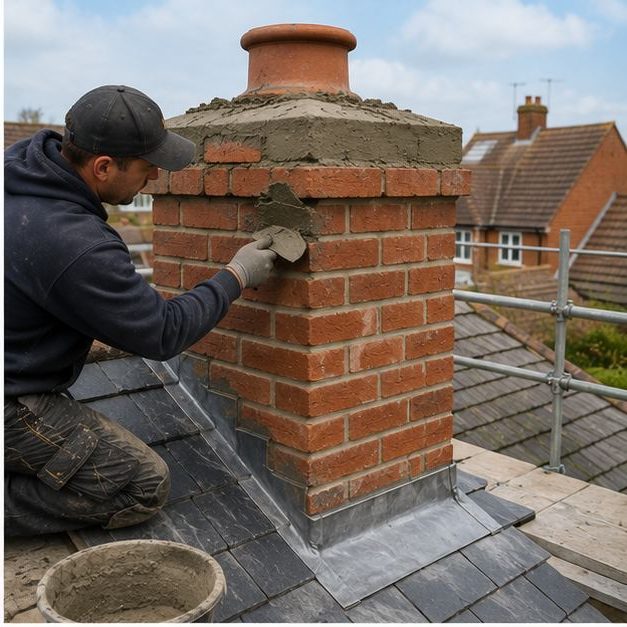
The lead itself typically sits in two parts: the step or apron flashing that covers the join between roof and chimney, and a chase — a groove cut into the mortar joint of the brickwork — into which the top edge of the lead is tucked and secured. Over years of expansion and contraction through hot summers and cold winters, the mortar holding that top edge in place can crumble and let the lead work loose, even while the sheet of lead itself is still perfectly sound.
Other common failure points include splits or cracks forming in the lead where it has fatigued from repeated movement, corrosion where lead has reacted with certain roofing materials or run-off, and simple physical damage from storms or from ladders and access equipment used carelessly during other work. On taller Victorian and Edwardian terraces of the kind found in parts of Lockleaze, the additional height and exposure can accelerate wear on flashing compared with a lower, more sheltered roof. Post-war properties in the area are not immune either, since flashing on a lower roof still has to cope with the same freeze-thaw cycles even if it is easier to reach when something does go wrong.
Repair options depend on the extent of the damage. Where the lead itself is sound but has simply worked loose from the chase, re-dressing and re-fixing it with fresh pointing is often enough. Where the lead has cracked, thinned or corroded, replacing the affected section with new code lead — cut and dressed to the correct profile for that chimney — is the more durable option, since patching failing lead rarely lasts as long as proper renewal.
It is worth checking the soakers and any back gutter behind the stack at the same time, since these smaller pieces of lead work alongside the main flashing and a fault in any one of them can cause a leak that looks, at first glance, like a flashing problem. A back gutter in particular is easy to overlook because it sits almost entirely hidden behind the chimney, yet a blocked or split back gutter is a common enough cause of leaks that it should always be part of a thorough inspection rather than an afterthought.
If flashing around a chimney in Lockleaze looks lifted, cracked or is simply old enough to be due a check, Brunel Roofing Bristol offers free inspections and will recommend repair or replacement honestly based on what we find, with all leadwork covered by our 15-year guarantee.
Get a Free Quote for Chimney Repairs in Lockleaze
Every chimney is different — the fastest way to get an accurate answer is a quick chat with our team.