
One of the most frustrating things about a chimney leak is that the damp patch you can see is very rarely directly beneath the point where water is actually getting in. Water travels along rafters, follows the underside of sarking boards, and tracks down the inside face of brickwork before finally showing itself as a stain on a ceiling or chimney breast, which means a leak in Lockleaze that looks like it is coming from one spot can genuinely originate somewhere else on the stack entirely.
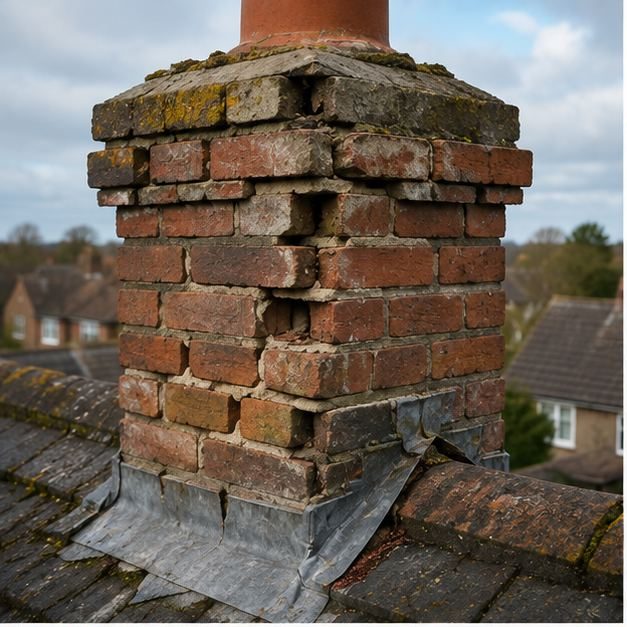
This is why a proper trace matters more than a quick patch. A roofer who simply seals whatever gap is nearest to the visible stain, without checking the flashing, flaunching and pointing further up the stack, can easily miss the real fault, leaving the leak to reappear at the next spell of heavy rain — often leading a homeowner to believe the repair simply did not work, when in fact the wrong point was ever treated.
There are a handful of usual suspects worth checking systematically. Lead flashing around the base of the stack is one of the most common culprits, since it relies on a tight seal against the brickwork that can work loose over time through thermal movement. Cracked or missing flaunching at the top, around the pots, lets rain run straight down inside the flue. Failed pointing on the stack itself allows water to soak through the brick rather than run off it. And on older properties, a genuinely porous or spalling brick can let water through the wall itself rather than through any joint at all. Each of these needs a slightly different fix, which is exactly why lumping them all together as a vague 'chimney leak' and guessing at a repair so often ends in disappointment.
Wind direction plays a part too, which can make leaks in Lockleaze properties seem intermittent or confusing — a joint that holds up fine in normal rain can let water in during a storm blowing from a particular direction, pushing rain up under flashing that would otherwise shed it. This is one of the reasons a single dry-day inspection sometimes misses the fault, and why a thorough trace considers the whole junction rather than just what is visible at a glance.
Once the actual source is identified, the repair itself is often more straightforward than the diagnosis — repointing a section of brickwork, re-dressing or replacing a length of lead flashing, or renewing the flaunching around the pots. The value is in getting the diagnosis right the first time, rather than paying for repeat call-outs chasing a leak that keeps finding a new way to show itself.
If you have got a chimney leak in Lockleaze that has proved hard to pin down, Brunel Roofing Bristol will trace it properly before recommending any work, with a free inspection, honest advice on what is actually needed, and a 15-year guarantee once the repair is carried out.
Get a Free Quote for Chimney Repairs in Lockleaze
Every chimney is different — the fastest way to get an accurate answer is a quick chat with our team.