
The edge of the roof is where wind attacks first. This guide explains how a dry verge holds the edge down, what it does not do, and when it makes sense.
Wind gets under a roof at its edges, and the verge at a gable end is one of the most exposed spots. In Bedminster, where terraces run in long rows and end gables face the open, a loose verge can let tiles lift in a gale. A dry verge is built to resist that, but it has limits worth understanding.
Why the edge fails first
Where the roof stops at a gable, wind can push up under the end tiles. With wet mortar, the bedding cracks and breaks away, leaving nothing to hold the edge down. Once one tile lifts, its neighbours follow. That is why edge failures after storms are so common on older roofs.
How a dry verge resists wind
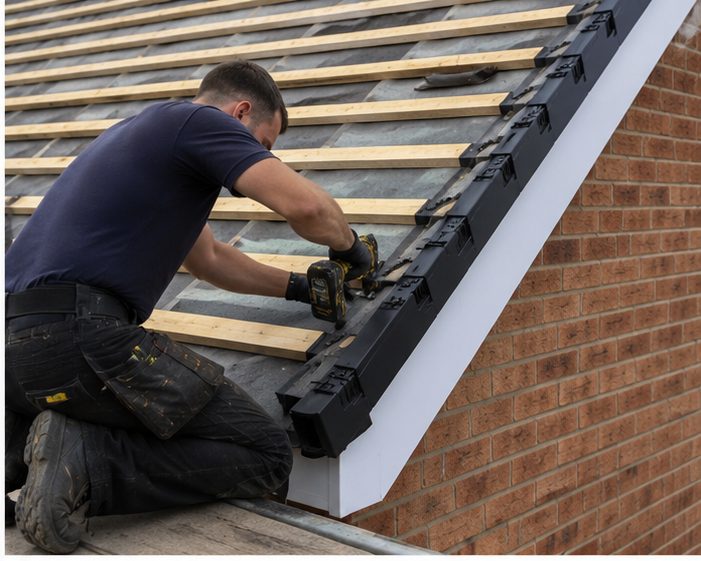
A dry verge uses mechanically fixed verge units and tile-end pieces, held down with fixings made for the job. There is no wet mortar to crack. The edge is clamped, so wind has far less chance to lift it. Fixing to a sound batten beneath is the key, which is why we check the timber first.
It is fitted to the tile maker's guidance, which sets out the fixing pattern for each tile type. Fitting is done to the tile maker's guidance, which sets out the fixing pattern for each tile type. We follow that pattern rather than improvising, because the whole point is a verge that stays put when the next gale comes through the terrace.
What it does not do
A dry verge strengthens the edge, but it cannot save a roof that is failing elsewhere. Slipped tiles in the field, perished felt and loose ridge pieces need attention separately. It also depends on sound battens beneath, since fixings need something solid to grip. We check all of this before recommending it.
- It does not cure slipped tiles elsewhere
- It cannot fix rotten battens beneath
- It does not replace a failing ridge
- It must suit the tile profile on site
Weather, birds and insects
The units also close the gap at the roof edge, keeping out driving rain, birds and insects. Wet mortar often leaves little gaps where wasps or starlings find a way in. A dry verge is a tidier, more complete seal at the edge, with nothing to crumble onto the path. Where the gable faces open ground at the end of a row, the benefit is greatest.
Checking suitability
Compatibility depends on the tile profile, and we check this on site before specifying anything. We look at the tiles, battens and gable wall together. If a dry verge suits, we explain how it will be fixed. If it does not, we say so, and suggest the best alternative for the roof you have.
Frequently Asked Questions
Will a dry verge make my roof storm-proof?
No roof is storm-proof. A dry verge makes the edge much more resistant to wind, but the rest of the roof still needs to be sound. We check the whole roof to see what else matters. It is also sensible to look at the ridge and hips at the same visit, since those take wind too.
Can it be added to an existing roof?
Often yes, particularly when the old mortar has failed. It depends on the tile profile and the condition of what is under it, which we check on site. If the batten ends beneath are rotten, we replace them first so the new fixings have something solid to hold.
Does a dry verge need maintenance?
Very little. There is no mortar to repoint. We would still check the edge as part of a regular roof inspection, and clean away any moss that builds up. Wasps and birds find it much harder to get in, which is a quiet bonus.
Talk to our team about dry verge systems in Bedminster
Every roof is different — the fastest way to get an accurate answer is a quick chat with our team.