
The edge of a roof is where wind does its worst. A dry verge holds that edge firmly in place, which helps, but it is only one part of a roof that stands up to weather.
On the rooftops of Redfield, where terrace gables stand clear of the surrounding rows, the verge takes the sharpest gusts. Wind curls over the gable and tries to lift whatever is at the edge. A mortar bed can crack and release; a mechanically fixed system is designed to resist that.
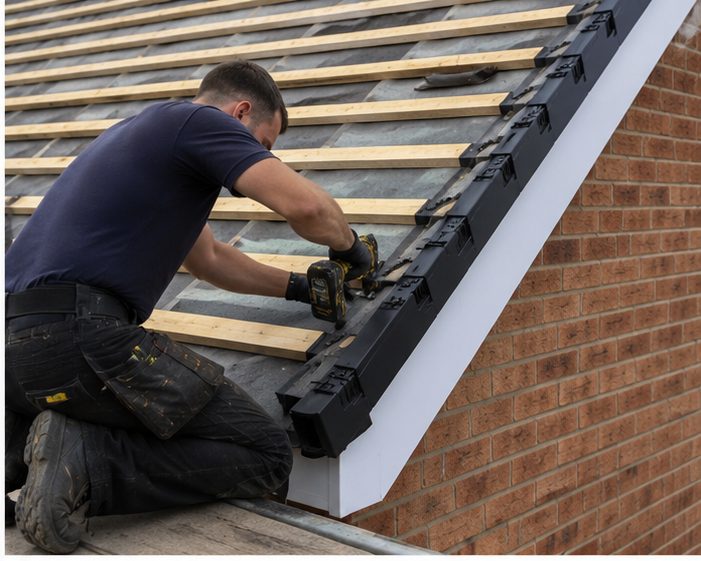
Why the edge is the weak point
Wind accelerates over a gable and creates uplift at the roof edge. If the verge tile is bedded only in mortar, once that bed cracks the tile can move, and the next wind loosens it further. The result is slipped tiles, torn felt and water getting in at the very edge where the roof meets the wall.
Gable ends in a terrace are often the highest and most exposed part of the street, which is why they tend to be the first to suffer when a strong gust comes through. A roofer reading the damage after a storm will often find the verge was where it began.
How a dry verge is fixed
A dry verge uses verge units and tile-end or cap pieces that are mechanically fixed through to the roof structure, usually with clips and screws or nails, following the tile maker's guidance. There is no wet mortar to crumble. The edge is held down by fixings and not by a brittle bed that wind and frost can break.
What improvement you can expect
With the edge fixed, wind has less to grab. The units also close the gap at the gable, keeping weather, birds and insects out. The result is a more resistant edge, though we do not promise that a roof will never lose a tile. Severe storms can test any roof, and fixings help it cope.
The improvement is greatest on roofs where the verge itself has been the weak spot, such as a gable edge that has lost mortar before, and smaller where the slope is already failing in several places away from the edge. We tell you honestly which situation we find.
- Edge held by fixings instead of a mortar bed
- Less debris falling to paths and yards
- Gaps at the gable closed against weather and birds
- Neater, more uniform line along the edge
Limits to bear in mind
A dry verge is not a cure for a roof failing elsewhere. If tiles are slipping across the slope, felt is perished or battens are weak, wind will find those points instead. Compatibility also depends on the tile profile, which we check on site. We look at the whole roof, explain what is urgent and what can wait.
We also check how the roof is held across the slope, because the edge depends on the tiles beside it being properly clipped and nailed. A good verge on a poorly fixed roof only moves the weak point inwards, so we look at the fixings along the first few courses.
When it is most useful
It suits new roofs, re-roofs and repairs where the old mortar has already failed. In Redfield, a falling mortar bed on a gable above a narrow path or yard is a common trigger. Ask for the fixing method to be explained and written down. Work may need planning or Building Regulations checks, and we advise before work starts.
Frequently Asked Questions
Will a dry verge stop tiles blowing off completely?
No system can promise that. A dry verge strengthens the edge and removes the mortar weakness, but a roof is only as strong as its weakest part, so we check the rest of the covering too.
Can a dry verge be fitted to any tile?
Not always. It depends on the tile profile and the units available to suit it. We check the tile type on site and tell you honestly if a dry verge is a good match, or whether another approach would work better.
Is it worth doing the verge on its own?
If the mortar has failed and the rest of the roof is sound, yes, it can be a sensible standalone repair. If the roof has other defects, we explain which to deal with first and why, so the money and effort go in the right order.
Talk to our team about dry verge systems in Redfield
Every roof is different — the fastest way to get an accurate answer is a quick chat with our team.