
The verge is where wind gets under a roof first. A dry verge holds that edge down mechanically instead of relying on mortar.
On exposed slopes with open gables, like many in Westbury-on-Trym, the roof edge takes a battering. Wind pushes at the verge, finds any weakness and starts to lift tiles. A dry verge is built to resist that. Here is how it helps, and where its limits lie.
Why the verge is the weak point
At the gable, wind can get under the edge tiles from the side and above. Wet mortar bedding has to hold them against that pressure, but mortar cracks as the roof and wall move. Once bedding loosens, edge tiles rattle and lift, and a strong gust can strip them. Exposed positions suffer the most.
Open, sloping ground means gusts arrive with little to slow them, and a gable end faces them head on. Inter-war semis and larger villas often have tall gables, so the edge is high and the forces on it are greater.
What a dry verge does differently
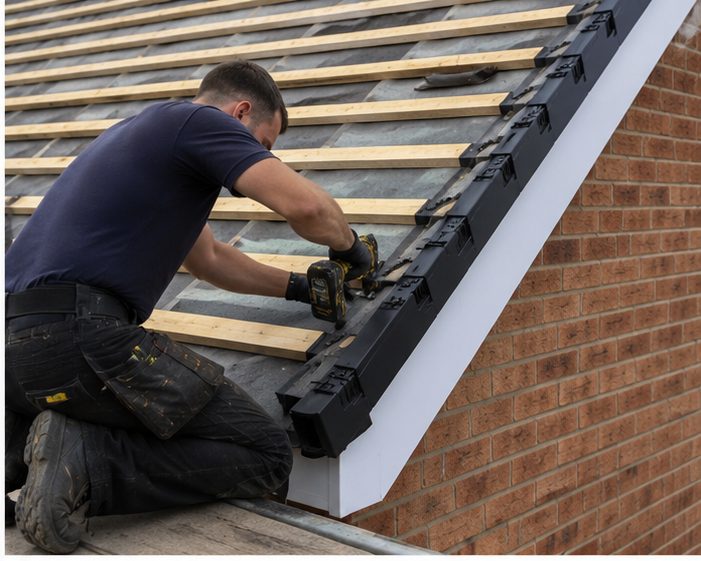
Instead of mortar, a dry verge uses mechanically fixed units and tile-end or cap pieces, held by fixings through to the roof structure. Because it is fixed rather than glued, it keeps its grip as the roof moves. It also closes the gap against weather, birds and insects that otherwise work at the edge.
- Edge tiles held down by fixings, not mortar
- No wet bedding to crack, shrink or fall out
- Gap sealed against weather, birds and insects
- Fixed in line with the tile maker's guidance
Better, not invincible
A dry verge improves wind resistance at the edge, which is where many wind failures begin, but it is not a cure-all. A roof with tired tiles, weak battens or rusted nails elsewhere will still fail elsewhere. We look at the whole slope, because an edge that holds is only useful if the roof behind it does too.
Wind resistance depends on the whole chain: the tile, the clip or nail, the batten and the fixing at the edge. A dry verge strengthens one link, and we check the others, because the roof is only as strong as its weakest part.
Does it suit every roof?
Compatibility depends on the tile profile, and we check this on site. Some tiles take dry verge units readily, others need a different approach. Older stone buildings and unusual coverings may call for a different detail altogether, and we tell you honestly if a dry verge is not the right answer.
When we fit them
Dry verges suit new roofs, re-roofs and repairs where mortar has failed. A common first sign is mortar dropping on paths or drives. If your gable edge is shedding, or you have lost tiles at the verge in a gale, it is worth having a look, from the ground first.
Frequently Asked Questions
Will a dry verge stop tiles blowing off?
It strengthens the edge, which is where wind often does its first damage, but it will not protect a roof that is failing elsewhere. We check the whole roof so that the improvement at the verge is not undone by weakness behind it.
Is a dry verge better than new mortar?
For wind resistance, generally yes, because it relies on fixings, not bedding that can crack. On the right roof it removes a recurring weak point, though we make sure the tile profile suits it before recommending it.
How do I know if my verge is at risk?
Look from the ground for mortar on paths, cracked or missing pointing, gaps at the gable edge or tiles sitting out of line. If you see any of these on an exposed gable, call us for a proper look.
Talk to our team about dry verge systems in Westbury-on-Trym
Every roof is different — the fastest way to get an accurate answer is a quick chat with our team.