
A flat roof covering that bubbles or opens up is reacting to something underneath or around it. Knowing the cause decides whether a patch will hold.
Flat roofs on extensions, garages, porches and dormers across Westbury-on-Trym, from villas to inter-war semis, take sun, frost and wind on their exposed tops. When the covering blisters, cracks or splits, the surface is showing a deeper cause. Reading the pattern tells us how serious it is.
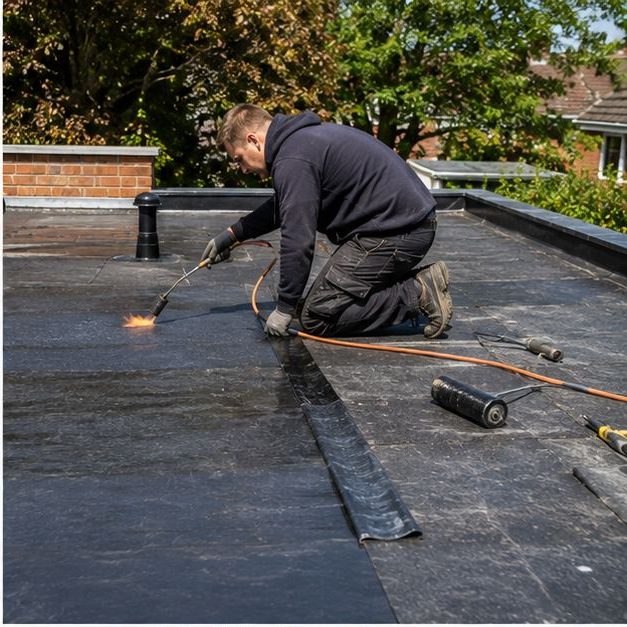
Blisters: moisture and heat
A blister is a raised pocket, usually filled with trapped moisture or air. Sun warms the covering, the trapped water turns to vapour and pushes the surface up. Blisters often start where the covering was laid onto a damp deck or where water has crept in through a nearby defect. A small blister may be harmless; a spreading cluster needs investigating.
Roofs over bay tops and dormers on the older villas can blister where small sections of covering meet tight corners, since the material is stretched and moisture finds it hard to escape. Those details deserve a careful look whenever blisters appear.
Cracks: age, sun and movement
Coverings harden and become brittle as they age, particularly where sunlight and temperature swings are strongest. The deck below moves slightly with weather and the structure of the building, and an old, stiff covering can no longer follow it. Fine cracks appear first, then open. Foot traffic and fallen branches from mature trees can start them as well.
- Brittle, crazed or chalky surface texture
- Cracks along the line of deck joints
- Splitting at corners and where the roof meets walls
- Damage from falling branches or foot traffic
Splits and failed joints
Splits tend to run along the weakest line, often a seam, upstand or edge trim. Joints that were poorly formed or have dried out open under movement, and water enters. Wind on exposed roofs can lift edges that are not held tight, which makes things worse. A split is rarely just a surface problem.
Why the cause matters
Patching over a blister without finding why it formed means it returns. A crack caused by a rotten deck needs the deck dealt with. We open a small area where needed, check for wet insulation or soft boards beneath, and then decide between repair and a full replacement.
On exposed sites, wind buffeting and rapid temperature changes add to the strain. A covering that looks sound from a window can already be failing at the edges, so we check the trims and upstands together with the main surface.
What we recommend
Where the covering is sound apart from a few defects, local repairs make good sense. Where blisters, cracks and soft areas are widespread, we recommend replacing the covering in single-ply rubber, fibreglass or a felt system, and fix any deck and insulation problems at the same time.
Frequently Asked Questions
Is a blister on a flat roof serious?
Not always. A single small blister on an otherwise sound roof can be watched or repaired. If blisters are multiplying, feel soft or sit near a leak, they suggest moisture beneath the covering, and the area should be opened and checked.
Can a split be sealed with a coating?
A coating may hide a hairline crack for a short while, but a moving split usually reopens. Lasting repair means cutting out the defect and fitting compatible material, or replacing the covering if it is failing generally.
Do trees make flat roof damage worse?
They can. Leaves block outlets, branches scratch or puncture the surface, and shade keeps moisture on the covering for longer. Keeping branches back and outlets clear helps, but any clearing of the roof itself should be left to us.
Talk to our team about flat roofing in Westbury-on-Trym
Every roof is different — the fastest way to get an accurate answer is a quick chat with our team.