
Fitting new boards over old timber sounds quick, but it only works when the wood beneath is sound. Often it is better to take the old boards off.
Fitting UPVC over existing timber is sometimes offered as a shortcut. For older stone buildings, villas and inter-war semis around Westbury-on-Trym, whether it works depends on what is behind the paint. Capping hides problems as well as protecting good timber, so we look carefully before saying yes or no.
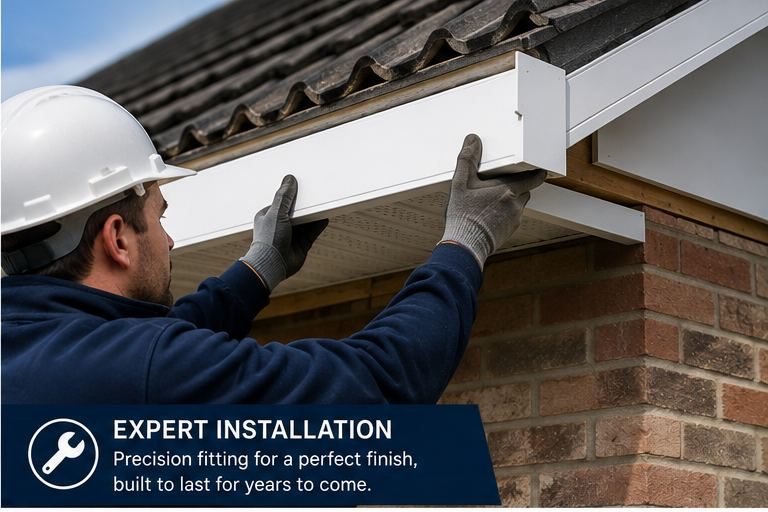
What capping means
Capping, or overboarding, means fixing new UPVC covers over the existing fascia and soffit timber instead of removing it. It is quicker and can be tidy where the wood is dry, straight and firmly fixed. It also leaves the old boards in place, so whatever condition they are in stays hidden behind the new face.
On older stone buildings and period villas, there is a further point: the existing boards may be part of the character of the eaves, so covering or replacing them changes the look. We talk through the profile and finish with you before choosing.
When it can be considered
Capping is only sensible when the timber is solid, the rafter ends behind are healthy, the gutters can be refitted properly and the existing boards are flat enough to take a neat finish. A quick tap and probe from a safe access point, and a look in the loft, tells us a great deal about the condition.
- Timber firm and dry throughout when tested
- Rafter ends and eaves free of damp or decay
- Boards flat and well fixed to the rafters
- Enough ventilation, or room to add vent strips
When replacement is the honest answer
If the wood is soft, split or wet, covering it only seals moisture in and the rot carries on out of sight. Gutters, which hang from the fascia, then loosen again. In that case we recommend removing the old boards, checking the rafter ends and fitting everything new, which gives a better, longer-lasting result.
Ventilation and older houses
The eaves should let the roof space breathe, and old closed-in soffits sometimes do not. Replacing the soffit allows vented boards or vent strips to go in. On older houses we also check what existing soffit boards are made of before disturbing them, and plan the work around that.
How we decide with you
We look from safe access, test the boards, check the loft and explain what we find before suggesting capping or replacement. Either may need planning or Building Regulations checks, and we advise before work starts. Choosing between them should depend on the timber, not on speed.
Whichever route is chosen, the gutters will need to come off and be refitted, so access has to be arranged. That gives us a proper chance to look at the rafter ends and eaves, which is the best test of whether timber is genuinely sound.
Frequently Asked Questions
Is capping always quicker than replacing?
It can involve less work, but the main point is whether it is right for the timber. If hidden decay is present, capping can cost more later when the problem resurfaces. We recommend what is sound, not what is quickest.
Will capping trap rot behind the new boards?
It can, if the timber is already damp. New boards seal the surface, and moisture can remain behind. That is why we test and look in the loft first, and only suggest capping where the wood is genuinely sound.
Do I still need new gutters?
Gutters have to come off to fit boards neatly and may be refitted if in good order. If they are cracked, sagging or leaking at joints, replacing them while access is in place is usually the sensible choice.
Talk to our team about UPVC fascias and soffits in Westbury-on-Trym
Every roof is different — the fastest way to get an accurate answer is a quick chat with our team.