
A dry verge fixes the roof edge mechanically, while mortar relies on a wet bed that can crack. Which suits depends on your roof, but for most the dry verge holds up better.
Where a roof ends at a gable wall, the verge needs finishing. Traditionally that meant mortar, and in Kingsdown many gables and party-wall ends still have it. It cracks and falls out over time. A dry verge is the modern alternative, and the choice depends on the tiles, the wall and how much access the roof allows.
How mortar verges behave
Mortar bedding is a traditional finish and can look right on an older house. But it is rigid, and the roof edge moves and takes the weather. Frost, sun and wind crack it over time. Pieces fall out, water gets into the gap, and the tiles beside it can loosen, particularly on exposed, steep roofs. Frost is a particular enemy of mortar on exposed, steep roofs, because water in a crack expands and pushes it apart.
How a dry verge works
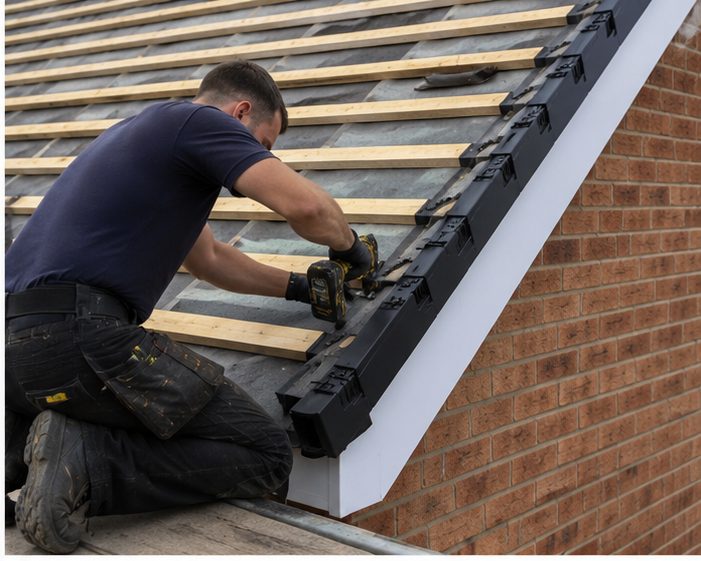
A dry verge uses mechanically fixed units along the edge, with a cap or tile-end piece to finish. There is no wet mortar to fail. It resists wind at the edge, keeps weather, birds and insects out, and is fixed following the tile maker's guidance. The line stays neat without repointing every so often. Because it is dry-fixed, the work is usually quicker on site than bedding and pointing mortar.
Where each one makes sense
A dry verge suits new roofs, re-roofs and repairs where mortar has failed. It is a practical choice where access is tight, because it avoids the repeated visits that mortar repairs can need. Mortar may still be right where a traditional appearance matters and the roof type does not suit dry units.
- Dry verge: lower upkeep and good wind resistance
- Dry verge: no falling mortar on paths or drives
- Mortar: a traditional look on some older roofs
- Mortar: needs periodic repair as it cracks
What decides it on your roof
Compatibility depends on the tile profile, and it is checked on site, not guessed. A dry verge is also not a cure for a roof failing elsewhere. On a Kingsdown terrace with party walls and limited access, we look at how the verge meets the wall and what the neighbouring roof is doing before advising. Party-wall verges are worth special care, since a failure there can let water run into the neighbouring property as well.
Our honest view
For most roofs where mortar has failed, we recommend the dry verge, because it removes the weak point rather than patching it. If your roof suits mortar and you prefer its look, we say so. Falling mortar on paths is often the first sign, so please let us know if you notice it. Tell us if you have seen fragments of mortar on the path, because that helps us gauge how far along the failure is.
Frequently Asked Questions
Is a dry verge always better?
For performance at the edge, usually yes. It is not always right for every tile type or look, which is why we check the roof on site before recommending it. If in doubt, ask us and we will explain what we find.
Can I keep the mortar look?
Some dry verge units are designed to look close to a mortar finish. We can talk through the options, though the exact look depends on the tile and the units that fit. If in doubt, ask us and we will explain what we find.
Does a dry verge need maintenance?
Very little. Mortar needs repointing as it cracks, whereas a dry verge has no mortar to fail. We still look over the edge during any roof check to make sure fixings and units are sound. If in doubt, ask us and we will explain what we find.
Talk to our team about dry verge systems in Kingsdown
Every roof is different — the fastest way to get an accurate answer is a quick chat with our team.