
Mortar has sealed roof edges for generations, but it cracks and falls away in the wind. This is how the two options compare on exposed ground like Kingsweston.
Traditional mortar bedding along a gable edge is simple and familiar, but it is brittle. Weather, movement and wind all work at it. On the open, high ground around Kingsweston Hill and Lawrence Weston the edge of a roof has little shelter. That makes the comparison between mortar and a dry verge system a practical question, not a matter of taste.
How mortar behaves at the edge
Wet mortar sets hard, and then the roof moves slightly with temperature and wind. The bedding develops cracks, water gets in, frost and damp break it up and pieces fall onto the drive or path. Once the bedding fails, tiles at the edge can loosen. Repointing helps for a while but does not change the way the material behaves. That cycle repeats every few winters on a windy edge, which is why people tire of it.
How a dry verge works
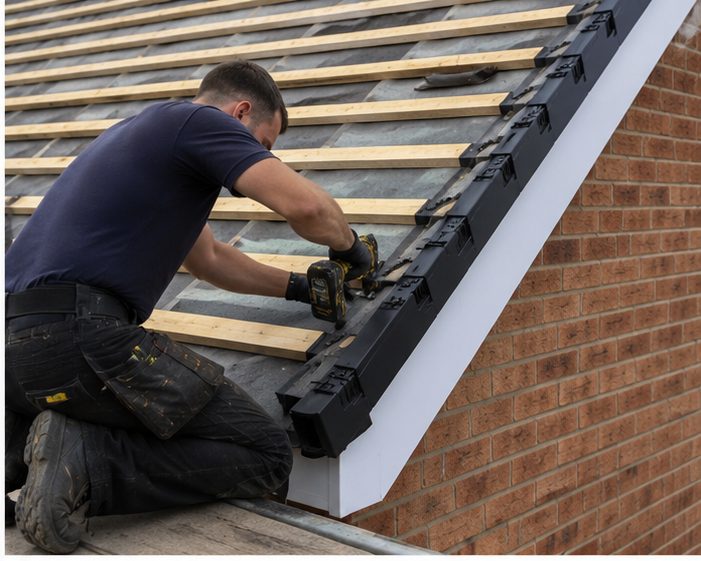
A dry verge uses mechanically fixed units and cap or tile-end pieces along the gable, with no wet mortar involved. The units are fixed to the tile maker's guidance. There is nothing to crack and fall, wind resistance at the edge is better, and weather, birds and insects are kept out of the roof void.
- No mortar to crack, shrink or drop out
- Fixed units resist wind lift at the edge
- Keeps birds and insects out of the roof
- Suits new roofs, re-roofs and failed-mortar repairs
Where mortar still makes sense
Some roofs, especially with older or unusual tiles, do not suit available dry verge units. In those cases a well-made mortar repair is the honest answer, and we will tell you so. Matching the look of an older roof can also be a reason to stay with mortar where the edge is otherwise sound. The decision should follow the roof, not a preference for a product.
Where a dry verge comes out ahead
For a re-roof or a verge that has failed more than once, a dry verge is usually the better long-term choice, particularly on exposed ground. It removes a recurring maintenance job and gives a neat finish. It is not a cure for a roof failing elsewhere, so the rest of the roof must be sound. Fewer return visits is the practical benefit most owners notice.
How we decide with you
We look at the tile profile, the state of the edge and the roof behind it, then explain both options in plain terms. You get a written description of the preferred route. If the roof is better served by mortar, we say that rather than steering you towards a system. We also explain what happens at the ridge end so there are no loose ends.
Frequently Asked Questions
Is a dry verge more expensive than mortar?
It depends on the roof and the work involved, so we give a written description of the job rather than a general answer. The better comparison is the repeated repair that mortar can need on exposed edges.
Will a dry verge look different from mortar?
Slightly. Units give a clean, even edge, often in a colour matched to the tiles. On some older roofs the look of mortar is part of the character, which we weigh up with you. Colour matching is part of the choice and we talk it through.
How do I know if my verge mortar has failed?
Small pieces on the path or drive are a typical first sign. From the ground you may also see cracks or gaps along the gable edge. Please do not climb up to check, and call us for a proper look.
Talk to our team about dry verge systems in Kingsweston
Every roof is different — the fastest way to get an accurate answer is a quick chat with our team.