
Timber fascias rot wherever water sits. Exposed post-war houses give it plenty of chances. This is what drives the decay and how replacement boards avoid it.
Wood does not rot because it is old. It rots because it stays wet. Timber fascias on the open, windswept parts of Kingsweston and Lawrence Weston get rain from the side, cold winds that dry them unevenly and gutters that overflow at the worst moments. Understanding where the water sits is the key to stopping the problem coming back.
Water that never dries out
Fascia boards sit at the very edge of the roof, directly beneath the gutter. Rain blown sideways soaks the face while overflow drips over the top edge. If the board stays damp for long periods, fungal rot sets in, starting at joints and the bottom edge where water collects. The top edge, hidden under the gutter, is often the worst without looking it.
Paint that has given up
Timber needs paint or stain to shed water. Once it flakes, the bare wood takes up moisture like a sponge. Repainting over a rotten board only hides the problem. Rot often starts under apparently sound paint, so soft spots, spongy patches and crumbling edges matter more than how the surface looks.
- Flaking or bubbling paint along the board
- Soft, spongy or crumbling edges
- Dark, wet staining around joints and corners
- Hairline splits that open after wet weather
Gutters and leaks above
A gutter that leaks at a joint, sags or overflows pours water down the same patch of board every wet spell. Blocked downpipes make it worse. We often find that the board rotted in one spot because the gutter above it was leaking for a long time, which is why the gutter is checked at the same time. Fixing the gutter at the same time stops the new boards suffering in just the same way.
Poor airflow and trapped damp
If the eaves cannot breathe, damp air in the roof space condenses on cold surfaces and the timber stays wet from the inside as well. Soffits without vents contribute to this. Good replacement work includes vented soffits or vent strips so the roof space can breathe properly. A loft that stays musty or shows damp near the eaves is a sign worth passing on to us.
How replacement breaks the cycle
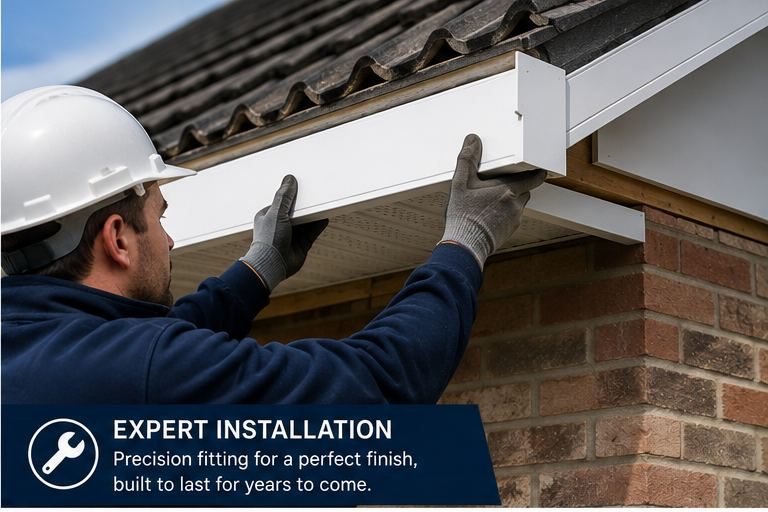
We remove the old boards and gutters, check the rafter ends and eaves, fit new boards and refit or replace the gutters. UPVC does not rot, it is cleaned rather than painted, and it is very low maintenance. On older houses we check what existing soffit boards are made of before disturbing them, calmly and as a matter of routine. Colour choices include white, darker shades and wood-effect, so the house keeps its character.
Frequently Asked Questions
Why does rot often start at the corners?
Corners and joints are where water collects and where end grain is exposed. Wind-driven rain and gutter overflow hit these spots hardest, so the board stays damp longer there than along its face. Corners also trap dirt that holds moisture against the wood.
Can rotten fascia boards be repaired?
Small areas of damage in otherwise firm timber can sometimes be dealt with. Where rot is widespread or has reached the rafter ends, new boards are the sensible choice, because patching only delays a bigger job.
Will UPVC fascias rot like timber?
No. UPVC does not rot, but it can still become dirty and needs the occasional clean. The fixings, joints and gutter still need to be correct, which is why the quality of the fitting matters. Gentle cleaning with a soft brush and water is usually enough.
Talk to our team about UPVC fascias and soffits in Kingsweston
Every roof is different — the fastest way to get an accurate answer is a quick chat with our team.