
Standing water on a flat roof is a warning, not just an eyesore. Here is why it happens, what we check and what the realistic fixes are for homes in Kingsweston.
A flat roof should drain, slowly perhaps, but fully. When puddles linger long after the rain has stopped, something is wrong. On the exposed post-war houses around Kingsweston, garage and extension roofs take plenty of wind, rain and leaf fall. Ponding adds weight and wear to the covering, so it is worth understanding before it becomes a leak.
The common causes
Most ponding comes down to a few things: falls that were never steep enough, a deck that has sagged or softened, a blocked or badly placed outlet, or a gutter that sits too high to take the water away. Sometimes it is a combination. Telling them apart is the first job, because each needs a different remedy. Age of the covering plays a part too, because a tired surface holds dirt and water more readily.
Blocked outlets and gutters
Leaves, moss and silt gather at outlets and in gutters, especially on roofs with trees nearby. If water cannot leave the roof, it stays. Clearing the blockage helps, but we also check why it blocked and whether the outlet is the right size and in the right place. Blocked gutters at ground level can be spotted from the garden; roof outlets are for us.
- Overflow staining on the wall below the roof edge
- Water standing at one corner after the rest has dried
- Green growth or silt gathered in one low patch
- Gutters overflowing in ordinary rain
Deck and structure problems
A sagging deck creates a dip that holds water, and rotten boards beneath the covering make it worse. We check from inside where we can for stained ceilings or soft timbers. If the deck is spongy underfoot when we inspect it, we say so honestly, because covering over a poor deck only hides the problem for a short time.
What we do about it
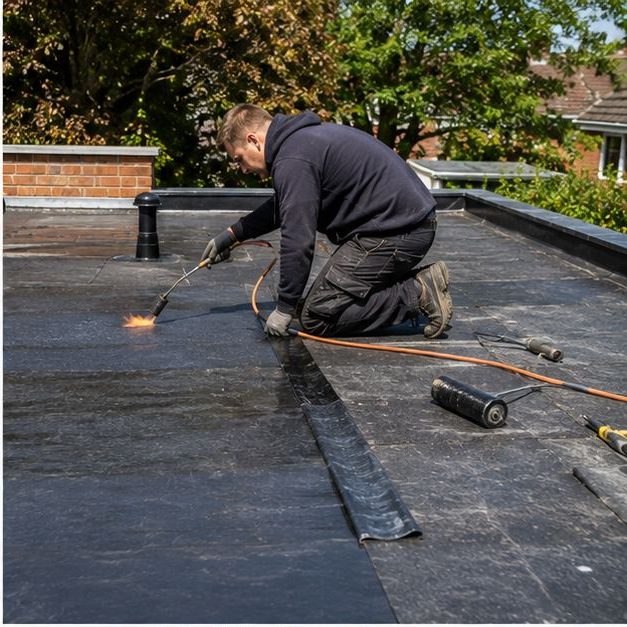
Where the covering is still sound and the cause is simple, such as a blocked outlet, a repair may be enough. Where falls are wrong, we may lay tapered insulation or boards to correct them as part of a re-cover. Where the deck has failed, it is replaced before any new covering goes on. We explain which route we recommend and why, so the decision stays yours.
What to ask before work starts
Ask what is causing the pooling, not just what will cover it. A good roofer explains whether the falls will be improved, whether the deck was checked, and what happens if rot is found halfway through. Get that in writing so there are no surprises when the covering comes off.
Frequently Asked Questions
Is a little standing water normal?
A thin film that dries soon after rain is common and usually harmless. Deep puddles that last for days point to poor falls, a blocked outlet or a dipped deck, and are worth having looked at. If it is still wet the next day, it is worth a look.
Will pooling water definitely cause a leak?
Not straight away, but it speeds up wear on the covering, joints and edges, and the weight can strain the deck. Over time it is a common route to leaks, so earlier attention usually means a smaller job.
Can ponding be fixed without a new roof?
Sometimes. If the covering is sound, clearing outlets or adjusting a small area may be enough. If falls or the deck are the cause, a proper fix means correcting those, which usually involves re-covering the roof. We explain the options before anything starts.
Talk to our team about flat roofing in Kingsweston
Every roof is different — the fastest way to get an accurate answer is a quick chat with our team.