
Both can work, but they fail in different ways. Here is a plain comparison of a dry verge and a mortar verge for Ridgeway's gable ends, extensions and garages.
A hipped roof has little verge, but many Ridgeway houses also have gable ends, garage roofs and extension pitches where the roof edge is bedded in mortar. When that mortar fails, you can re-bed it or switch to a dry verge. Which suits depends on the roof, the tiles and what you want.
How a mortar verge works
Tile ends are bedded in sand and cement along the gable edge, then pointed. When it is fresh it looks neat and holds firmly. The weakness is that mortar is rigid and shrinks, while roofs flex in wind and temperature. Over time it cracks, loosens and falls out in pieces.
Weather is the other factor. Gable ends on exposed corners take wind and rain from one direction, so mortar on that side tends to go first. On a hipped house that mostly spares the main roof, the verges that do exist, on a gable porch or a garage, often get less attention and fail unseen.
How a dry verge works
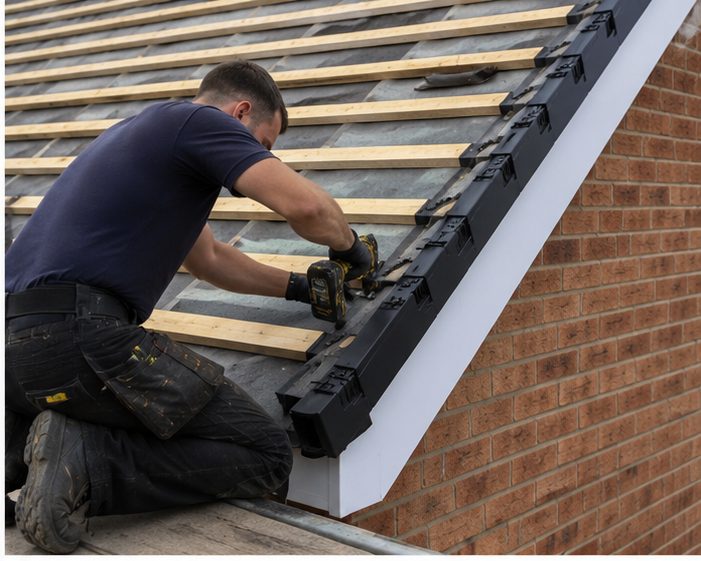
Dry verge units are fixed mechanically along the edge, with matching end pieces over the tile ends. There is no wet mortar to crack, so the edge stays closed. It is held with clips and screws to the tile maker's guidance, and it suits new roofs, re-roofs and repairs where mortar has failed.
- Mechanically fixed units, so nothing to shrink or crack
- Cleaner edge with no mortar falling onto paths
- Quicker to fit than careful re-bedding
- Works with many common tile profiles
Where mortar still makes sense
On some older or unusual tiles, a dry verge system may not fit the profile. A repaired and re-bedded mortar verge, done well, can be the right answer. It also suits a roof where a traditional look matters. We check the tiles on site before recommending either, not from a catalogue.
Repairs to mortar are sometimes the more modest answer where only a short stretch has failed. Replacing a few lengths of bedding while leaving the rest can be sensible, as long as the remaining mortar is sound. We tell you honestly where a patch will hold and where it will not.
What a dry verge will not fix
A dry verge does not cure a roof that is failing elsewhere. If the felt is tired or tiles are slipping across the main slope, a new verge is a small part of a bigger picture. We say so and look at the whole roof, so you do not pay for an edge on a roof that needs more. We also tell you if a garage or extension roof has a different type of edge, since not every pitch uses the same detail.
Choosing between them
Ask what is failing, what is proposed and why, and how each option is fixed to the roof. Ask how the edge will look and what upkeep follows. If you have falling mortar, cracks along the gable or a leaning tile end, tell us and we will explain which route suits your roof.
Frequently Asked Questions
Is a dry verge more expensive than mortar?
It depends on the roof and the work involved, so we explain the difference on site rather than in general. What matters is that the edge is properly held and stays closed, which a dry verge is designed to do.
Will a dry verge look different from mortar?
Slightly. The verge units have a clean, even line, and the end pieces are matched to the tile. Most people find the result tidy. We can show you the options so you can see the finish before work starts.
Can I switch from mortar to dry verge on an old roof?
Often, yes, where the tile profile allows it. We check that the system fits and can be fixed securely before suggesting it. If it will not suit the tiles, we say so and explain the alternative.
Talk to our team about dry verge systems in Ridgeway
Every roof is different — the fastest way to get an accurate answer is a quick chat with our team.