
A dry verge closes the roof edge where mortar has failed. For birds, bees and wasps, that means one fewer way into the roof. Here is what it changes at gables and extensions.
Gable ends, extension pitches and garage roofs around Ridgeway often have verges with mortar that has aged and cracked. Gaps in that mortar are an invitation to birds and insects. A dry verge replaces the mortar with fixed units, and this guide explains what that does for nesting.
Where the gaps come from
Mortar along a verge shrinks and cracks as it ages, and weather washes it out. Small cracks become holes behind the tile ends. Starlings and sparrows look for dry, sheltered gaps like these, and wasps and bees will nest in the cavity. You may notice crumbs on the drive or birds going in and out.
Gable ends on garages and extensions are easy to overlook. A verge on a low roof beside a drive or side path can be just as open as one on the main house, and birds use low edges as readily as high ones. We look at every verge on the property, not only the obvious one.
What the dry verge closes
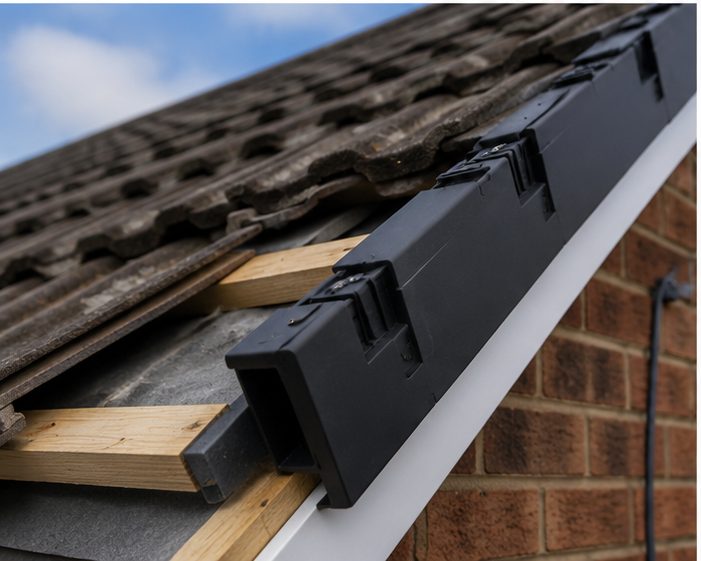
Verge units and end pieces are fixed tight against the tile ends. There are no loose joints for birds to push into and no cavity for insects to settle in. The edge stays closed against weather too, so rain and wind-driven debris cannot get under the tiles.
- Fixed units leave no open cracks along the edge
- Tile-end pieces close the small gaps between tiles
- The edge stays tight without needing repointing
- Birds look elsewhere for a nest site
Dealing with nests already there
We check for nests before starting. If birds are in an active nest, we do not disturb it and talk to you about timing. If there is a wasp or bee nest in the cavity, we advise on having it dealt with by a pest controller before the edge is closed, so nothing is trapped behind it.
The timing of work can matter. If nesting is under way, we may suggest leaving that edge until the birds have finished, and carrying on with other parts of the job. That is a plain conversation we have with you at the survey, with no pressure to rush the closing of the edge.
Other entry points
Closing the verge does not close every route. Gaps at the eaves, behind ridge or hip tiles, around vents and under soffits can still be used. On a hipped house with garage and extension roofs there are plenty of edges. While we are on site we look at those too and tell you where birds may try next. We would rather you knew that than assumed one fix covers the whole roof.
A cleaner edge afterwards
Without crumbling mortar there is less to sweep from paths, and gutters stay clearer of nest material. Wildlife that used to live in the cavity moves on. If you hear scratching in the roof space afterwards, tell us, as it may be another entry point we should look at.
Frequently Asked Questions
Will starlings still try to nest on the roof?
They may look at other gaps, particularly under eaves or hips. A closed verge removes one of their usual spots. We check the rest of the edge, so there are fewer easy places left.
Is a dry verge bad for wildlife?
It removes an access point to the roof space, which is the point of it, but it does not take away habitat in gardens or trees. Where bats are known to use a roof, we advise before work.
Can I tell if birds are in my verge?
Look from the ground for droppings, nest material poking out, or birds going in and out at the gable edge. Do not poke at it or climb up. Tell us what you see and we will check.
Talk to our team about dry verge systems in Ridgeway
Every roof is different — the fastest way to get an accurate answer is a quick chat with our team.