
Traditional mortar verges look neat on day one but tend to crack and fall. Dry verge units avoid that. We compare the two and say when each makes sense.
The gable edges of Shirehampton houses face the westerly wind head on. A mortar verge bedded in wet cement has been standard for generations, but it relies on a bond that weather gradually breaks. A dry verge uses fixed units instead. Neither is right everywhere, so here is how they compare in practice.
How a mortar verge behaves
Mortar sets hard but not flexibly. The roof and wall move slightly with temperature and wind, and over time the bond cracks. Pieces fall out onto paths and drives, leaving gaps that let in weather, birds and insects. Repointing helps for a while, but the edge is still depending on a material that weathers.
On a gable that takes the wind off the river side, the stress on that edge is steady and repeated. A cracked verge may look minor from the pavement, but it is often the start of loose tiles along the gable end.
How a dry verge works
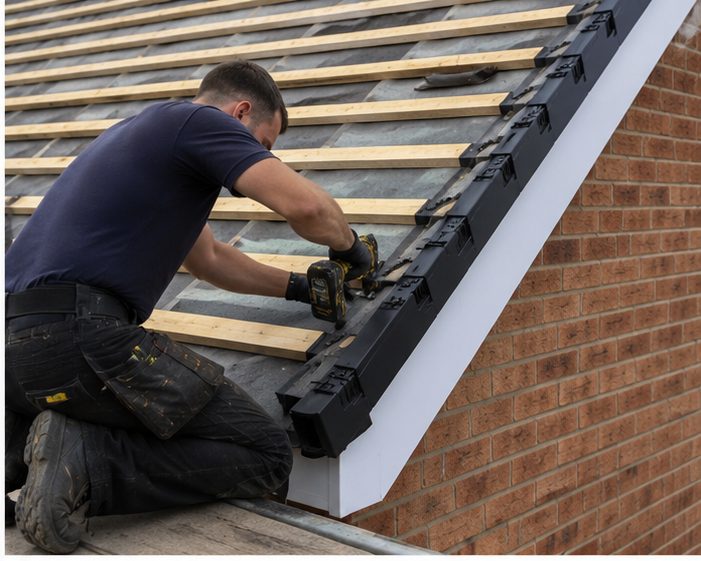
A dry verge uses purpose-made units fixed mechanically to the roof edge, with tile-end or cap pieces covering the gap. There is no wet mortar to fail. Because the pieces are screwed or clipped in place, the edge is held against wind uplift, which suits the exposed side of a house.
- No mortar to crack, crumble or drop
- Mechanically fixed against wind uplift
- Keeps weather, birds and insects out
- Fitted to the tile maker's guidance
Where mortar still makes sense
Some roofs, especially with unusual or historic tiles, do not have a matching dry system, and a well-made mortar verge may suit the look of the house. Where mortar is kept, the detail must be done carefully and the owner should expect to check it from time to time.
Even then, we would explain the upkeep honestly, so you know the edge may need looking at again after harsh weather. A mortar repair is a fair choice when it suits the roof, but it should be chosen with open eyes rather than out of habit.
What decides it
Tile profile, the condition of the edge and how exposed the gable is carry the most weight. A new roof or full re-roof is the easiest time to choose a dry verge. For a repair where mortar has failed, a dry verge can replace the broken section, provided the neighbouring tiles are sound.
Our straightforward view
Where the tile suits it, a dry verge is usually the better answer for a wind-exposed edge, because the failure point has gone. It is not a cure for a roof that is failing elsewhere. We check the profile and the whole roof on site, then tell you which route fits, and why.
Frequently Asked Questions
Is a dry verge better than mortar?
In most cases where the tile allows it, yes, because there is no mortar to fail and the units are fixed against wind uplift. Compatibility with the tile profile decides, and we check that on site rather than assuming, so you are told plainly if mortar is the better fit for the house.
Can I swap a failed mortar verge for a dry one?
Often yes. The old mortar is removed, the edge is checked, and compatible units are fixed in its place. The surrounding tiles and battens need to be sound enough to take the new fixings, and we look at that closely before the work is agreed with you.
What is the first sign a mortar verge is failing?
Usually crumbs or chunks of mortar on the path or drive below, followed by visible cracks or gaps along the gable edge. If you notice either, stay on the ground and call us, and we will take a proper look at the whole edge.
Talk to our team about dry verge systems in Shirehampton
Every roof is different — the fastest way to get an accurate answer is a quick chat with our team.