
Swapping crumbling mortar for a dry verge changes the roof edge from a ragged strip to a neat, continuous line. How it sits beside your tiles and brickwork is worth thinking through first.
People often worry that a dry verge will look modern against older stone or brick. In Chipping Sodbury, where historic buildings sit alongside newer estates, the answer depends on the gable, the tile and the colour. Done carefully, the edge usually looks tidier than mortar that has cracked, stained and been patched over the years.
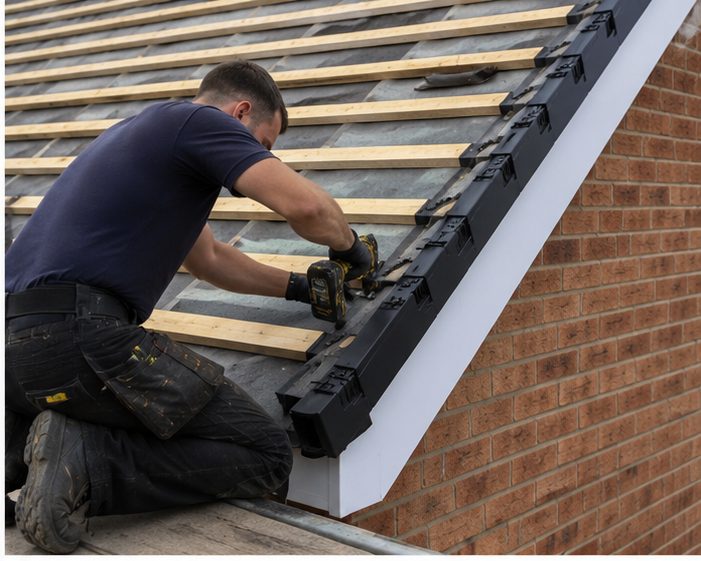
The edge line
Mortar verges are uneven by nature. Patches differ in colour, joints vary and gaps open up with age. A dry verge gives a straight, consistent line along the gable, with the tile-end pieces sitting evenly. On a long gable the difference is noticeable from the street, particularly where old repairs have been layered over one another.
Where a gable faces the road, that straight line becomes part of how the whole house reads, because the eye follows the edge of the roof down to the wall before it notices anything else about the building. On a long gable, that one clean line can lift the look of the whole elevation.
Colour and finish
Verge units come in a range of colours chosen to sit alongside common tile finishes. The aim is to match the existing roof closely enough that the edge blends in rather than stands out. Because tiles weather, we look at the actual colour on your roof, not just the original catalogue shade, when we talk through options.
- Match to the current tile colour, not the original
- Consider how the edge sits against brick or stone
- Check the finish in daylight, not only on a sample
- Ask what is used at the ridge and hips nearby
Older buildings and the street view
Historic buildings give a roof a character that a new edge should respect. Where the verge is visible from the main street, the choice of colour and profile matters more. We talk this through honestly: sometimes a dry verge is a good fit, and sometimes a conventional edge is better for the building. We advise before any work starts.
What changes and what does not
The wall below, the tiles above and the pitch of the roof all stay the same. What disappears is the band of cement-coloured mortar. In its place, you have a fixed edge piece that looks drier and cleaner, and does not stain the gable wall or leave debris on the path below.
There is also less to maintain visually. Mortar tends to stain the wall below as it weathers, while a fixed edge unit sheds water cleanly and stays the colour it was fitted. That means the gable wall stays cleaner for longer, with fewer streaks running down from the roof edge.
What to ask before you choose
Ask to see the unit and the tile it will sit beside, and whether it suits your tile profile. Ask how the verge is fixed and what happens at the ridge end. A good roofer will describe this in writing and show you where the new edge sits, so you know what the gable will look like when the work is done.
Colour and finish are worth settling before work starts. A short conversation about the tiles you already have, and how the new units will sit beside them, avoids any surprise or disappointment when the scaffold comes down and the edge is on show to the whole street.
- Will the unit suit my tile profile?
- How is it fixed along the gable?
- What happens where the verge meets the ridge?
- Can I see a sample against my tiles?
Frequently Asked Questions
Will a dry verge look out of place on an older house?
Often it does not, especially when the colour is matched carefully. On a historic building we discuss it first, because in some cases a conventional edge suits the property better. We give you our honest view either way.
Does the colour fade or stain differently from tiles?
Both age slightly differently, so the match is made to the weathered colour on your roof today. We explain what to expect and what the edge pieces will look like beside the tiles after the work.
Is the look the only reason to choose a dry verge?
No. It also resists wind lift at the edge, has no wet mortar to fail, and keeps weather, birds and insects out. Appearance is a bonus, but the practical benefit is usually the main reason.
Talk to our team about dry verge systems in Chipping Sodbury
Every roof is different — the fastest way to get an accurate answer is a quick chat with our team.