
The stain on the ceiling is rarely under the hole. Tracing a flat roof leak means working backwards from the damp, checking every joint, upstand and outlet, then repairing only what the evidence supports.
A flat roof leak can travel a long way before it shows. Across Chipping Sodbury, extensions, garages and porches on older and newer houses all rely on a thin covering and a handful of joints, so the entry point is often some distance from the stain. Finding it properly is most of the job.
Start from the inside
We begin where the damp shows, noting its position, whether it is wet or old, and whether it appears only after heavy rain. Ceiling stains, soft plasterboard and damp at the top of walls all give clues. Water moves along the deck and insulation, so the true entry point is often higher up or to one side.
Walking the roof surface
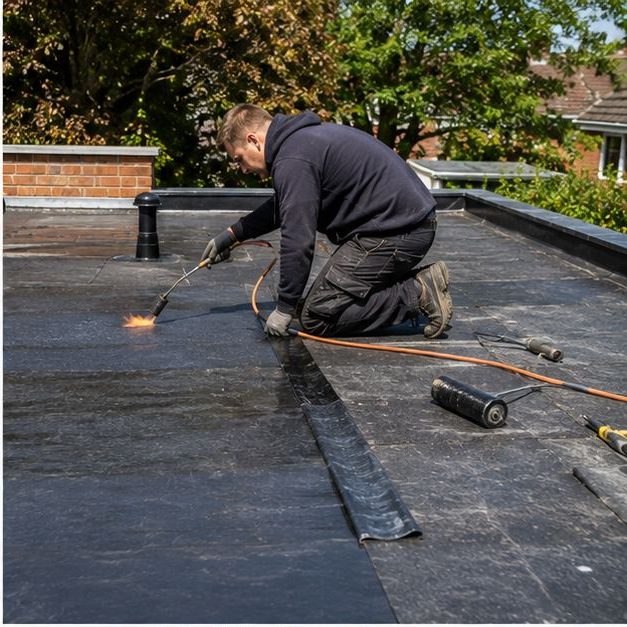
Once on the roof, we look at every place where water can get in. Most leaks start at details rather than in the open surface: where the covering meets a wall, around rooflights, at edges and around pipes. Open areas fail too, but usually show cracks, blisters or splits you can see.
- Upstands and wall junctions where covering has lifted
- Edge trims and drip details
- Joints, laps and seams that have opened
- Outlets, pipes, penetrations and rooflights through the covering
When the covering is not the whole story
Sometimes the surface looks fine and the water is coming from a failed joint, a blocked outlet or standing water that has found a weak spot. A damp deck can also hold water and release it slowly. We test and probe where needed, and lift a small area if the evidence points beneath the covering.
Where the deck is found wet or rotten, we say so and show you what we have found. Covering laid over damp or soft timber will only fail again, so the deck has to be dealt with first, and that may change the scope of the job.
Repair, patch or replace
Where the roof is sound apart from a specific fault, a repair is the honest answer: reseal a joint, renew a trim, replace a damaged section. If cracks, blisters and wet insulation are widespread, patching only chases the next leak, so we say that plainly and describe replacement options in general terms, such as single-ply, fibreglass or felt systems.
What to ask any roofer
A clear written description of what was found and what will be done matters more than a quick verbal answer. Ask where the water entered, whether the deck is dry and sound, and what happens if rot is found once the covering is lifted. A good tradesman explains rather than guesses, and leaves the site tidy.
Keep a note of any new stains and the weather when they appeared. That small record helps us a great deal on a return visit, and it often points straight to the part of the roof that needs another look.
- Where exactly did the water get in?
- Is the deck dry, or has it been damaged?
- What is repaired and what is left alone?
- Is the work described in writing first?
Frequently Asked Questions
Why does the ceiling stain not sit under the leak?
Water runs along the deck, insulation and joists before it drips. The stain shows where it finally escapes, not where it entered. That is why we trace from the damp back across the roof rather than assuming the nearest point.
Can I seal a leak myself with a bitumen product?
Please do not. It means going onto the roof, and sealing over the wrong spot can trap water and hide the real fault. Tell us what you have seen and we will find the true entry point.
Will the whole roof need replacing?
Not necessarily. If the problem is a joint, trim or upstand and the deck is sound, repair is sensible. If the covering is cracked and split widely, or the deck is rotten, replacement is likely to be the better route.
Talk to our team about flat roofing in Chipping Sodbury
Every roof is different — the fastest way to get an accurate answer is a quick chat with our team.