
A dry verge replaces the line of mortar at a roof edge with fixed units, and the gable looks different as a result. Here is what you will see on a Horfield house and how to judge it.
People often ask whether a dry verge will look out of place. The answer depends on the house and the roof around it. In Horfield, where Victorian and Edwardian terraces sit alongside inter-war semis and later extensions, roof edges vary a lot. A dry verge gives a different kind of finish to a mortar edge, and it is worth knowing what changes.
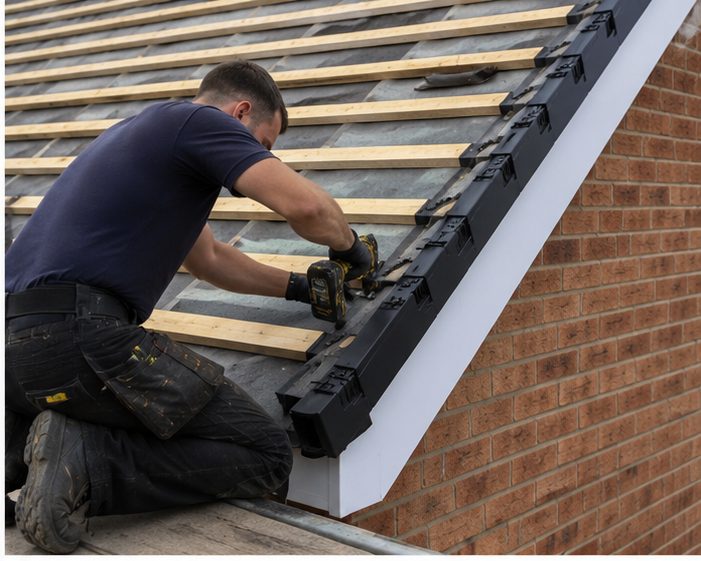
What you actually see
With a traditional verge you see a band of cement along the gable edge, often weathered, stained or patched. With a dry verge you see a neat plastic or composite unit running along the edge, tucked under the last tile, with matching end pieces at the ridge and eaves. The result is a cleaner, more uniform line. There are no mortar crumbs, no moss-stained cement and no patchwork of repairs of different ages.
Colour and profile
Units come in a range of colours made to sit alongside common tile finishes. We match as closely as we can to your existing tiles, though some slight variation is natural next to weathered roof tiles. Over time the contrast usually softens. The unit also has to suit the tile profile. A flat plain tile and a deeper pantile need different pieces, and the shape of the verge line will look different on each. We check this on site rather than guess.
Gable ends in older streets
On Victorian and Edwardian houses the gable is often part of the character, and some owners want the edge to stay close to its original appearance. A dry verge is a modern product, but it sits tight to the wall and lets the tile pattern remain the main feature. On inter-war semis and extensions, where the roof edge is already simpler, a dry verge tends to blend in more easily. If you are re-roofing, the edge is simply designed as part of the new covering.
- Cleaner line along the gable edge
- No cement staining running down the wall
- Neat matching end pieces at ridge and eaves
- Colour chosen to suit the existing tiles
More than appearance
Looks are one part of the answer. Fixed units hold the end tiles down against wind, stop weather reaching the timber beneath and keep birds and insects out of the roof edge. These benefits go with the neat finish. If you share a roof with a neighbour, say so. A matching terrace may look more consistent if neighbouring gables are treated alike, and it is worth a conversation over the garden fence.
Questions to ask before you choose
Ask to see the unit or a sample, and ask how it is fixed. A sensible roofer describes the work in writing and explains whether your tile profile suits it. If the roof is failing elsewhere, they should tell you rather than only quoting for the edge. Work like this may need planning or Building Regulations checks — we advise before work starts.
Frequently Asked Questions
Will a dry verge match my existing tiles?
We choose the closest colour available, but weathered tiles and new units will not be identical at first. The difference usually settles as the roof weathers. If a close match matters to you, tell us before we order.
Does it look modern next to older houses?
It looks cleaner than aged mortar, but it is a different material. On older Horfield houses we keep it tight to the wall so the tiles stay the main feature. We can show you options before work begins.
Can it be added to just one gable?
Yes, a single gable can be done where the tile profile suits. Some owners prefer to match both sides of the house for consistency. We advise on whether treating one edge or both makes more sense.
Talk to our team about dry verge systems in Horfield
Every roof is different — the fastest way to get an accurate answer is a quick chat with our team.