
Tiles move for a handful of reasons, and a single slipped tile is often a symptom rather than the problem. Here is what causes slipping and cracking on Horfield roofs and how we deal with it.
A slipped tile is easy to spot from the pavement, but the cause is usually hidden underneath. Horfield has Victorian and Edwardian terraces, inter-war semis and plenty of extensions, and each of those ages its tiles and fixings differently. Understanding why a tile has moved decides whether a quick refix will last or the same gap reappears.
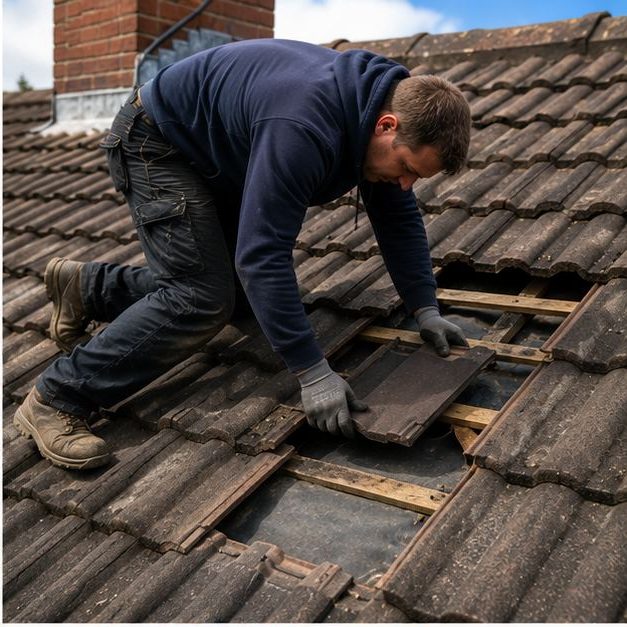
Fixings that have given up
Older tiles are held by nibs hooking over battens, with clips or nails on only some courses. As battens dry out and nails corrode, the hold weakens and a tile can creep down the slope, particularly after a spell of wind or frost. It leaves a gap that lets water onto the felt.
On many inter-war semis the original fixings were minimal by modern standards. A tile that has slipped is often telling us its neighbours are only held by their own weight, so we check the surrounding courses and not just the obvious one.
Cracking from weather and movement
Clay and concrete tiles both crack. Frost gets into small pores and splits the surface, and thermal movement works hairline cracks wider over time. Debris trapped behind a tile can hold water against it and speed the damage. Cracks often start at the edge where a tile overlaps its neighbour.
Foot traffic is another common cause. Someone going onto a roof for an aerial, a gutter or a quick look can crack tiles that appear fine until the next heavy rain. This is another reason we advise leaving roof access to people with the right equipment.
- Frost splitting porous tiles over a cold spell
- Hairline cracks widening with movement
- Debris holding water against a tile
- Heavy boots on tiles that are already tired
- Impact from falling branches or windblown debris
Why the roofline matters
Where a roof was altered, the age of the tiles can change from one slope to the next. Extensions and dormers are often tiled in a different batch to the main house, with different spacing and bedding. Joints between old and new are where we most often find slipped or loose tiles.
Valleys, hips and ridges also take the brunt of weather. If the bedding mortar beneath has weakened, tiles along those lines can lift or slide, and we look at them when we look at the field of the roof. Those lines are where several faces of the roof meet and water concentrates.
What we check from loft to ground
From the loft we look for daylight, stained felt, damp battens and rotten timber, which tell us how long water has been getting in. From outside we look at the tile pattern, gutters, ridge and the underside of the eaves. The point is to find the true source rather than just the visible gap.
We also judge how tired the roof is as a whole. A few isolated slipped tiles on an otherwise sound roof is a repair. Many cracked tiles across a slope tells a different story. The rest of the slope tells us which of the two applies.
A repair that stays put
A proper repair replaces broken tiles with a matching profile, refixes the loose ones with the right clips or nails and checks the felt and battens beneath. If the felt is torn we deal with it rather than laying a tile over a hidden problem.
Where cracking is widespread, we say honestly whether continued repairs make sense or whether replacing the covering over that slope is the better route. Bigger jobs may need planning or Building Regulations checks — we advise before work starts. Either way, you hear it from us before any work starts.
Frequently Asked Questions
Can I just slide a slipped tile back myself?
We would rather you did not. Working on a pitched roof is dangerous, and a tile put back without checking the batten and felt beneath often slips again. Photograph it from the ground, note any stains in the loft and call us for a proper look.
Will a cracked tile always leak?
Not always at once. A hairline crack may only let water through in driving rain, while a larger split lets it reach the felt every time. Over time the felt and timber beneath suffer, so a cracked tile is worth having looked at before the damage spreads.
Do slipped tiles mean I need a new roof?
Not usually. A few slipped or cracked tiles on an otherwise sound roof is a repair job. If many tiles are failing across a slope, or the fixings and felt are tired, we will explain that and talk through the options honestly.
Talk to our team about roof repairs in Horfield
Every roof is different — the fastest way to get an accurate answer is a quick chat with our team.