
Replacing the roofline is a sequence, not a single task, and each step matters. Here is how the work runs on a Horfield house, from putting access up to refitting the gutters.
Fascias and soffits look like simple boards, yet the job touches the gutters, the eaves and the way the roof space breathes. On a Horfield terrace, semi or extension we follow the same order every time, so nothing is left to chance. This guide walks through it so you know what to expect on your house.
Access comes first
Work at the eaves needs safe, stable access, which usually means scaffolding or a tower, particularly on two-storey houses and terraces with a long run of roofline. We agree with you where it goes and for how long it will be there, so you can move cars and plants. Good access also lets us see the eaves properly. Trying to judge them from a ladder or the ground is how problems get missed.
Taking the old roofline off
We remove the gutters first, then the old fascia boards and soffits. Because the boards sit tight against the rafter ends, removal is done carefully to avoid damaging the roof edge or the tiles above. On older houses we check what the existing soffit boards are made of before disturbing them. If anything unusual is found, we stop and explain how it will be handled safely.
Checking what is behind
With the boards off, we look at the rafter ends, the wall plate and the underside of the roof edge. Wet or rotten timber is dealt with now, not covered. Birds, insects and damp often leave signs here that were impossible to see from outside. This stage is where honest conversation matters. If rafter ends need repair or the felt at the edge has failed, we tell you before carrying on.
Fitting the new boards and ventilation
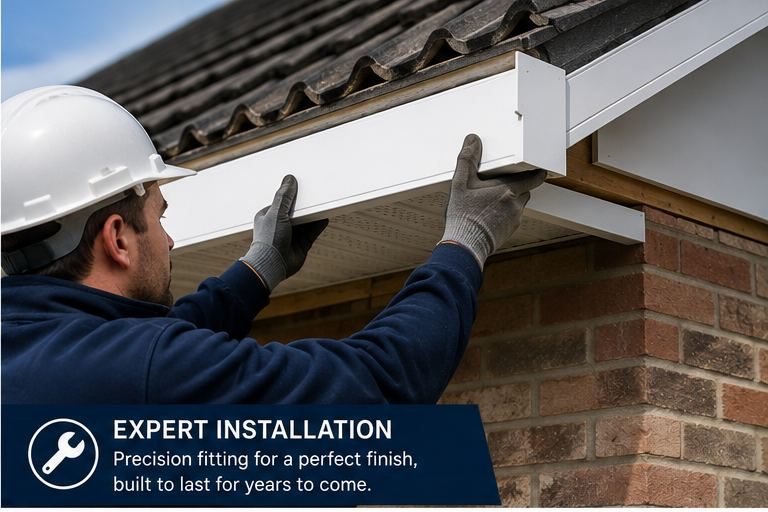
New fascia and soffit boards are fixed to sound timber, cut neatly at corners and joined so water cannot get behind. We use vented soffits or vent strips so that the roof space can breathe, which helps stop condensation and damp in the loft. Finishes are available in white as well as darker and wood-effect options. Most people in Horfield choose to match the look of the rest of the house, and we will help you pick.
- Vented soffits or vent strips for airflow
- Neat corners and sealed joints
- Fixings into sound rafter ends
- Finish chosen to suit the house
Gutters and finishing
Gutters are then refitted or replaced, set to a gentle fall towards the downpipes so they drain properly. Old brackets and tired joints are often best renewed while access is in place. We clear away the old boards, tidy the site and leave the scaffold until the job is checked. Any work that may need planning or Building Regulations checks — we advise before work starts.
Frequently Asked Questions
Will the roof space be disturbed?
Mostly only at the eaves. The loft itself is not entered unless we need to check something from inside. We cover the ground and keep the work contained, and we will tell you if anything needs access to the roof space.
Is scaffolding always needed?
For most houses, yes. Safe access is needed to remove the old boards, check the rafter ends and fit new ones properly. Low single-storey sections such as garages or porches may be reachable with a lighter set-up.
How noisy and messy is it?
There is some noise as old boards come off and debris is cleared. We protect paths and drives, collect waste as we go and tidy up when finished, so that you are left with neat boards and clear surroundings.
Talk to our team about UPVC fascias and soffits in Horfield
Every roof is different — the fastest way to get an accurate answer is a quick chat with our team.