
The verge is the edge of the roof at a gable. A dry verge is a fixed, mortar-free way of finishing it. Here is how it works and where it suits.
The verge is the edge of a pitched roof where it meets the gable wall. For generations it was finished with a strip of mortar, which cracks and drops out in time. A dry verge replaces that with units that are fixed mechanically, and it is increasingly used on Brislington's garages, extensions and gable-ended homes.
The old way: mortar on the edge
Traditionally the tiles at the gable were bedded in a strip of wet mortar. Weather, frost and the movement of the roof make that mortar shrink, crack and eventually fall out. A first sign is crumbs on the path or drive below, followed by loose tiles at the edge and gaps where weather and birds can get in. Lower roof edges on garages and extensions are just as exposed as the main house.
What a dry verge actually is
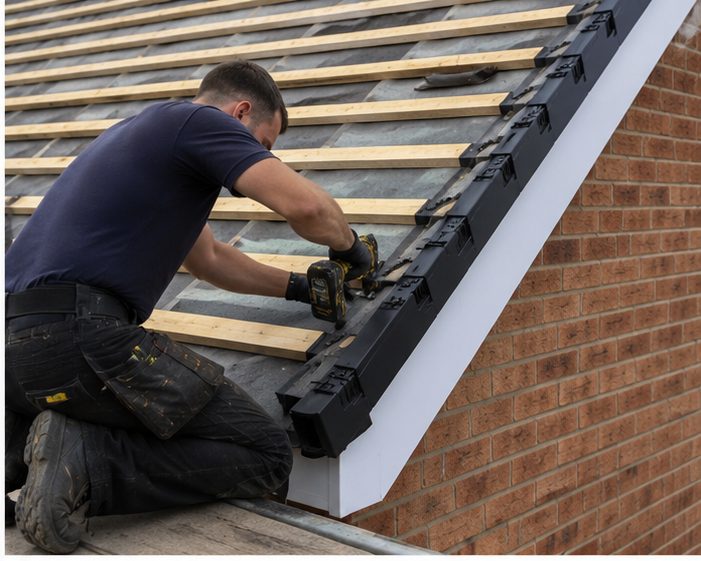
A dry verge system is made up of verge units that run along the roof edge, with tile-end and cap pieces to finish the corners and the ridge end. They clip or screw to the roof structure and the tiles, so the edge is held firm without wet mortar. The result is neat, uniform and quicker to complete. Different tile profiles need different units, so the system is chosen to match.
Why it performs better at the edge
The roof edge is where wind pulls hardest. Mechanical fixing gives better resistance there than a strip of mortar, and there is nothing to dry out or crack. The system also closes the gap along the verge, which helps keep weather, birds and insects out of the roof space.
- Mechanical fixing for good wind resistance at the edge
- No wet mortar to crack or fall away
- Closed edge against birds and insects
- Neat, consistent appearance along the verge
Where it suits
It suits new roofs, re-roofs and repairs where the old mortar has failed. It is fixed to the tile maker's guidance, so we make sure the system matches your tile profile. A dry verge cannot rescue a roof that is failing in other places, so we look at the whole covering before recommending it.
What to ask when someone proposes one
Ask what units are being used, how they fix, and how the old mortar and loose tiles will be dealt with. Expect to be told whether your tiles are compatible and what condition the edge is in. If the answer is vague, ask again. A good roofer explains the detail without fuss. You should be able to follow the explanation without any specialist knowledge.
Frequently Asked Questions
Does a dry verge need any maintenance?
It is very low maintenance, since there is no mortar to break up. We still recommend a look from the ground now and then for anything unusual, such as a shifted tile or debris, particularly after bad storms. The aim is that you do not have to think about the edge for a long time.
Is a dry verge only for new roofs?
No. It suits new roofs and re-roofs, and it also works as a repair when old mortar has failed, provided the tiles and edge can take the system. We check compatibility on site before suggesting it.
Will it look different from my current verge?
Usually the edge looks neater and more uniform than aged mortar, though the exact finish depends on the system and your tile. We can describe what to expect on your roof when we visit. We talk it through before any work starts.
Talk to our team about dry verge systems in Brislington
Every roof is different — the fastest way to get an accurate answer is a quick chat with our team.