
Ridge tiles and lead flashings do the sealing at a roof's most exposed joints. This is what repairing them involves on Brislington's hipped semis, extensions and older village-core houses.
Ridge tiles cap the top of the roof and the hips, while lead flashings seal where the roof meets a wall, chimney or another roof. Both sit at joints that weather hard. In Brislington, with so many hipped roofs and extensions, they are among the repairs we are asked about most often.
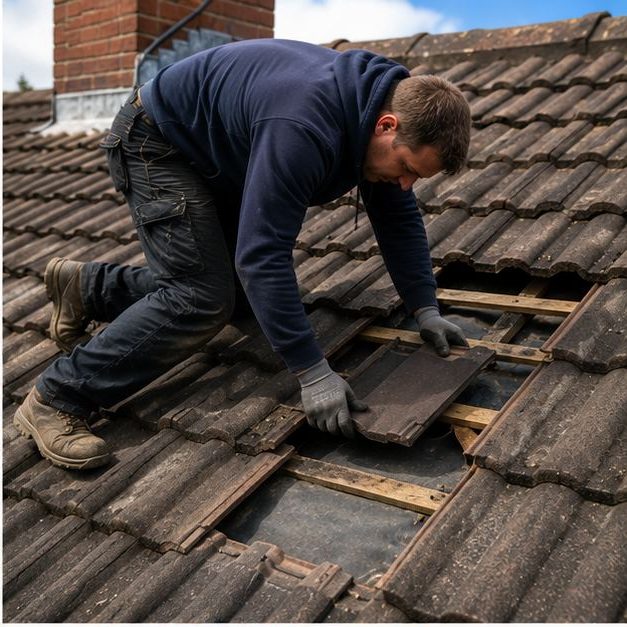
What the ridge and hip tiles are doing
Ridge tiles run along the top of the roof and hip tiles run down the sloping corners of a hipped roof. They are bedded on mortar or fixed with a dry system to keep rain out of the gap where two slopes meet. A hipped house has a lot of this joint to look after, and the hip ends are the usual weak spot.
Signs the bedding is failing
Mortar under ridge tiles dries out, cracks and falls away, which loosens the tiles and lets wind and rain underneath. You may spot crumbs of mortar in the gutter or on the drive, or tiles that look crooked along the line when you stand back and look up from the pavement. Cracked or slipped tiles beside the ridge are a further hint that the bedding has moved.
- Pieces of mortar in gutters or on paths
- Ridge or hip tiles sitting out of line
- Visible gaps or dark lines under the ridge
- Damp or daylight in the loft near the top of the slope
How a ridge re-bed is carried out
We lift the loose tiles, clear the old bedding, relay them on fresh mortar or a fixing system suited to the roof and point the ends neatly. Any cracked tiles are replaced with a match as close as we can find. Hip tiles at the corners get the same treatment, with particular attention to the hip end where the slopes meet and the tile is under the most strain.
Lead flashings at chimneys, walls and valleys
Lead is dressed into the brickwork and over the tiles so water runs off rather than behind. It fails when it lifts, splits or the pointing holding it falls out. Repair may mean re-fixing and re-pointing the edge, patching a split or replacing a length. On shared semi walls and extension joins we check the whole run, not just the visible gap. Shared walls between semis get particular attention because a failure there can feed water into both houses.
Repair or replace, and what to ask us
If the damage is local we repair it. If bedding or flashings have failed along the whole length, replacing them is more honest than patching. Ask what is being removed, what is going back and how the joint will be sealed, and expect a clear written description of the work before it starts. Older village-core houses may have different tiles and detailing, so we match what is there.
Frequently Asked Questions
Do ridge tiles always need re-bedding?
No. If the bedding is sound and only a tile or two is cracked, replacing those may be enough. We look at the condition along the full length of the ridge and hips before deciding, and we explain the reasoning to you.
Can lead flashing be repaired or must it be replaced?
Small splits and lifted edges can often be repaired or re-fixed. Where lead is worn thin, cracked in several places or badly distorted, a new length is usually the sounder fix. We judge it on site and show you what we find.
Will the work make a mess at the house?
We keep the site tidy and clear debris from paths, gutters and drives as we go. Old mortar comes down during a re-bed, so we protect and sweep the areas below, and we leave the property as we found it.
Talk to our team about roof repairs in Brislington
Every roof is different — the fastest way to get an accurate answer is a quick chat with our team.