
The middle of a flat roof is rarely where it fails. Edges, trims and upstands take the strain, and here is why they leak on Brislington extensions and garages.
On a flat roof, the main area of covering usually copes. The trouble starts where it stops: at the edge, against a wall, around a rooflight. Garages and extensions on Brislington's semis have plenty of these details, and each one depends on a small piece of workmanship staying sealed. Here is what goes wrong and how we sort it.
Edges: where water leaves the roof
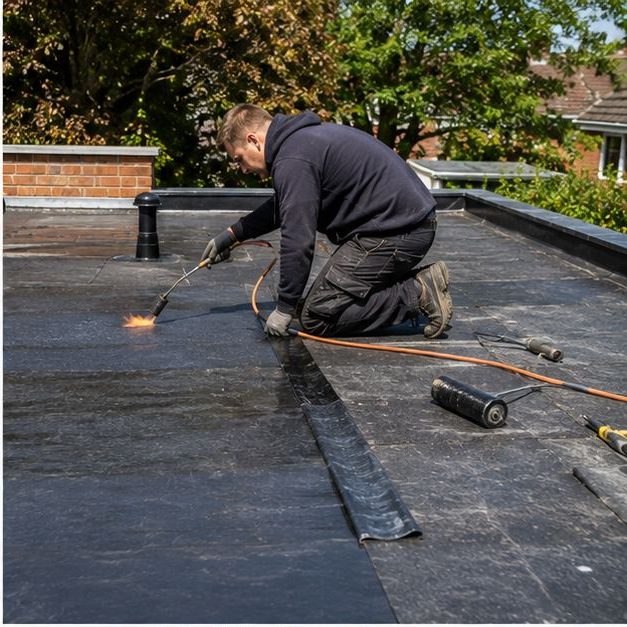
The edge trim guides water into the gutter. If it lifts, cracks or was never fixed properly, water runs back under the covering or down the face of the wall. Timber behind it then rots quietly. Edge leaks often show as stains on the outside wall or a damp ceiling near the perimeter. Over a bay top or porch the same applies.
Upstands and abutments against the house
An upstand is the covering turned up a wall, and an abutment is where the roof butts against the house. On an extension or garage attached to a semi, this joint carries all the rain running down the wall above. A flashing or sealing strip lets go over time, and water tracks in behind it. Rain running down the house wall lands directly on this joint.
Movement is the usual cause
A flat roof extension moves differently from the house it is joined to. Over time that movement opens joints, stretches the covering at the corners and pulls trims away. Sun, frost and wind-driven rain all work at the weak spot, so a small gap turns into a steady leak in a heavy downpour. Garage roofs butted to a house wall are especially prone.
- Sealant that has dried, split or shrunk back
- Flashing or termination bar working loose from the wall
- Corners where the covering has stretched or cracked
- Gaps behind edge trims or drip strips
- Water ponding against the wall instead of draining away
How we trace an edge or upstand leak
We inspect the roof edge and every junction, then compare with the stain inside. We look at what is behind the trim and whether the deck has gone soft. Because water travels, we confirm the entry point before we remove anything, so the repair deals with the actual source. Stains inside a ceiling can sit well away from the true entry point. We take photos along the way so the findings are clear to you.
Putting it right
Repairs vary from re-fixing a trim and resealing a termination to renewing the upstand covering and replacing a flashing at the wall. Where timber has rotted we cut it out and replace it first. We explain what failed and, if other junctions look similar, flag them so you can decide with the full picture. Any rotten timber is replaced before new covering goes on.
Frequently Asked Questions
Can sealant alone fix a leaking upstand?
Sometimes as a short-term measure, but sealant ages and splits. A lasting fix usually means refixing and properly terminating the covering at the wall. We tell you which applies once we have seen the detail up close. Sealant is a patch, not a rebuild.
Why is the damp on the wall below my flat roof?
Water running down from a failed edge or gutter line often shows on the wall or ceiling beneath, away from the actual fault. We trace it back along the roof rather than treating the stain where it appears. That is how we find the real cause.
Do roof edges need replacing as well as the covering?
Often it makes sense to renew them together, since trims sit under or beside the covering. If the trims are sound, they can stay. We check their condition and fixings before advising you either way. It avoids opening the same area twice.
Talk to our team about flat roofing in Brislington
Every roof is different — the fastest way to get an accurate answer is a quick chat with our team.