
A dry verge swaps the mortar line at a gable for fixed, purpose-made pieces. Here is what the parts are, how they stay put, and why they suit the exposed edge of a pitched roof.
Look at the gable edge of a roof and you will see the verge: the strip where the tiles stop and the wall begins. Traditionally it is sealed with mortar. A dry verge does the same job with fixed units and cap pieces, so there is no wet mix to crack and drop out over the seasons.
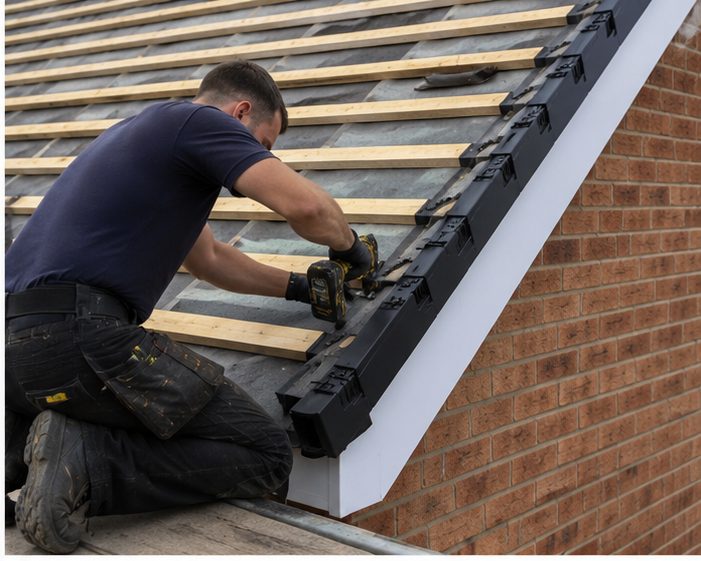
The parts of the system
A dry verge usually has three elements: an undercloak or support that carries the edge, verge units that sit over the tile ends, and cap or end pieces that finish the ridge junction. Each is fixed down with screws or clips, in the pattern the maker specifies. Because the pieces are made for the purpose, they fit the roof edge in a way that hand-finished mortar cannot always match.
How it holds in the weather
The gable edge catches the most wind on a roof, because air is forced up and over it. Fixed units resist that lift, where a mortar bed relies on the grip of old, shrinking material. With no mortar there is nothing to wash out or fall off. The units also close the gap at the edge, keeping rain, birds and insects out of the roof space.
Why it fits the terraced roofs here
Terraces and later blocks have gable edges at the ends of rows, and those ends are the most exposed part of the roofline. A fixed edge there means less upkeep and less chance of debris landing on a path or yard below. It also suits repairs where the mortar has already failed, without rebuilding the whole roof.
- No mortar to crack or crumble
- Fixed edge resists wind lift
- Keeps birds and insects out
- Neat, even line along the gable
What it does not do
A dry verge is not a cure-all. If tiles elsewhere are slipping, or the felt is worn out, fitting a new edge will not stop a leak further down the slope. It improves the edge and nothing else, and we say that clearly, because a tidy verge on a failing roof only delays the real conversation. Compatibility depends on the tile profile, which we check on site before recommending anything.
What to expect on the day
We take off the old mortar and any broken edge tiles, check the timbers and underlay beneath, and fit the units along the gable with the fixings in place. The work is tidy and mostly confined to the edge, with debris cleared at the end. If you have noticed falling mortar or loose edge tiles, mention it when you call and we will bear it in mind.
Frequently Asked Questions
Is a dry verge the same as a dry ridge?
They are related ideas applied to different parts of the roof. A dry verge covers the gable edge, while a dry ridge deals with the top line. Both use fixed pieces in place of mortar, and both are checked for tile compatibility.
Can the old mortar just be repaired instead?
It can, and some roofs only need that. But mortar tends to fail again in the same way, so a fixed system is often a better long-term answer. We can price either approach and explain the trade-off honestly.
Will a dry verge need maintenance?
Very little. An occasional look from the ground for loose pieces after rough weather is sensible. If anything looks displaced, call us and we will inspect it. The system has no mortar to repoint, which is much of the appeal.
Talk to our team about dry verge systems in Lawrence Hill
Every roof is different — the fastest way to get an accurate answer is a quick chat with our team.