
The flat surface of a roof is rarely where the water gets in. The edges and the upstand against the wall are. Here is why those details fail on Lawrence Hill extensions and what a proper fix involves.
A flat roof is only as good as its edges. The membrane across the middle has no joints to speak of, but at the perimeter and against the house wall it has to turn up, turn down and be sealed in several directions. On the rear extensions of Lawrence Hill terraces, those details are where leaks begin.
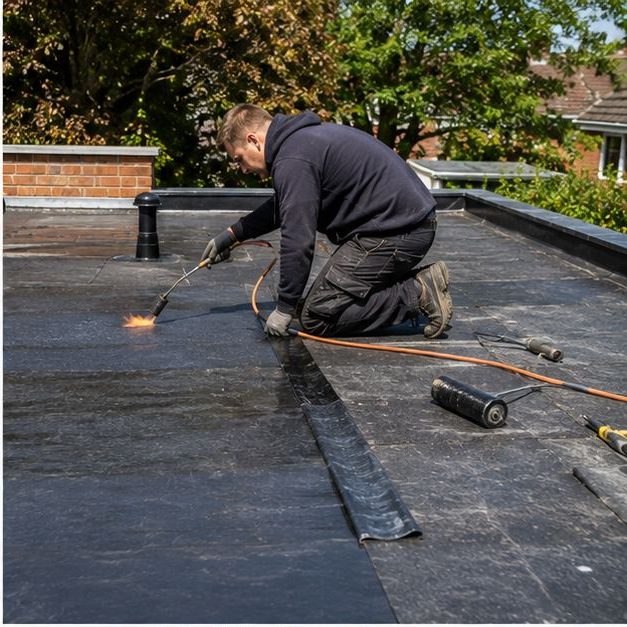
The upstand against the house
Where the flat roof meets the main house wall, the covering is turned up the brickwork to form an upstand and then covered by a flashing. Movement between the old wall and the newer extension can pull that seam open, and the flashing can lift as the wall pointing behind it deteriorates. In a terrace this junction is often long and awkward, so there is more of it to go wrong.
Edge trims and drips
At the outer edge, a trim guides water into the gutter. If that trim has loosened, cracked or been fitted with too little overhang, water runs back under the covering or down the face of the wall instead of off the roof. Look from the ground for water marks beneath the edge, green staining on the brick below, or a trim that sits visibly out of line.
Why the damage often shows far from the edge
Water entering at the perimeter rarely drops straight down. It runs along the deck and joists and reappears at a light fitting, a ceiling corner or the top of a window. People then assume the middle of the roof has failed, when the edge is the real entry point. Tracing from the stain back to the nearest upstand or trim saves a lot of unnecessary work.
- Stains in the ceiling corner nearest the house wall
- Damp patches that follow the line of the edge
- Drips that appear only in wind-driven rain
- Peeling paint at the top of an internal wall
How we repair them
For an upstand, we clean back the area, check the substrate behind, and refit the membrane up the wall at the proper height with a new flashing dressed over it. For an edge, we renew the trim so it falls into the gutter and bond the covering so it cannot lift. If the deck at the perimeter has gone soft, that section is replaced first, since good covering over poor boards will not last.
Keeping edges working
Gutters and outlets next to the roof need to run freely, because an overflow soaks exactly these details. Debris in a valley gutter or outlet is a common reason an edge keeps getting wet. We can look at the whole perimeter in one visit and tell you what needs doing now and what can wait. Please do not climb up to clear it yourself.
Frequently Asked Questions
Can sealant fix a leaking upstand?
It can slow a small leak for a while, but sealant on its own rarely lasts where the wall and roof move against each other. A proper repair rebuilds the junction with covering and flashing so it can flex without opening.
Why does the leak only show in windy weather?
Wind drives rain sideways and upward against the wall, forcing water behind a weak flashing or under a lifted edge. In still rain the same gap may stay dry. Intermittent leaks are very often edge or upstand faults.
Do the edges need to be replaced if the roof is otherwise fine?
Often not. Edge trims and upstands can be renewed on their own when the main surface is sound. We check how the covering has aged elsewhere, and tell you if the problem is likely to be wider than it first looks.
Talk to our team about flat roofing in Lawrence Hill
Every roof is different — the fastest way to get an accurate answer is a quick chat with our team.