
Some fascia boards can be saved with a careful repair, others have gone too far. This is how we tell the difference on older terraced homes and what the choice means for the roof edge.
On a terrace of Victorian houses, the fascias have been through a lot of weather. Some are still sound under flaking paint. Others are soft right through and only look presentable from a distance. Deciding between repair and replacement is a matter of testing the board and looking at what lies behind it.
What we test first
We look at the board for soft spots, splits along the grain and open joints, and we check how well it still holds the gutter brackets. A screwdriver tip pressed into sound timber meets resistance. In rotten timber it sinks in, and that tells us how far the decay goes. We also check the rafter ends behind the board, since the damage often starts there.
When a repair is reasonable
If the decay is local, perhaps one short section near a leaking gutter joint, the bad piece can be cut out and a new length spliced in. The board is then prepared and finished, and the gutter fixed back with new brackets. This suits a fascia that is otherwise straight, firmly attached and in decent order along the rest of its length.
- Damage confined to one short run
- Rest of the board firm with tight fixings
- Rafter ends behind it sound and dry
- Gutter alignment can be put right
When replacement makes more sense
Widespread softness, boards that have bowed, repeated paint failure and decay that reaches the rafter ends all point the same way. A series of small repairs on a failing board costs time and leaves a poor result, so we recommend new boards instead. Replacement also lets us fit proper ventilation to the soffit, which a patch cannot do.
What replacement looks like
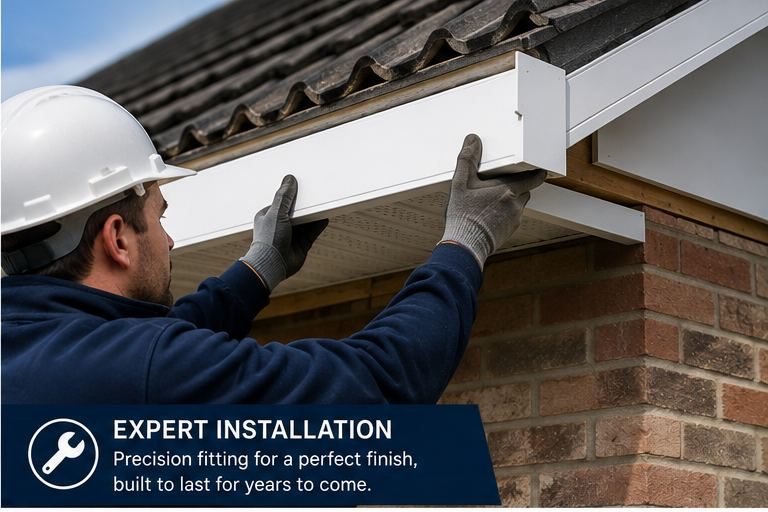
Gutters come down, old boards are removed, and we inspect the rafter ends and eaves before anything new goes on. New boards are fixed, soffits are fitted with vents or vent strips, and the gutters are refitted or renewed. Access is arranged safely, usually with a scaffold on a terraced front. UPVC is very low maintenance, needing a wipe rather than repainting, and comes in white as well as darker and wood-effect finishes.
An older home calls for care
On many older terraces we check what the existing soffit boards are made of before we disturb them, and we adjust the way we work if that is needed. It is a routine step and we explain it before the work begins. Ask any contractor how they will handle that, how they will protect the wall below while boards come off, and how they will leave the eaves when they have finished.
Frequently Asked Questions
Can I paint over a rotten fascia?
Paint will hide the decay for a short time but does not stop it. Soft timber continues to break down underneath, and the gutter keeps sagging. If the board is soft, it needs repair or replacement before any decorating.
Will new UPVC boards suit an older terraced house?
Yes, in most cases. Plain white is the usual choice, and darker or wood-effect finishes are available if you prefer a more traditional look. We can show you the options and how they would sit against your brickwork.
Does replacing the fascia mean replacing the gutter?
Not necessarily. The gutters have to come down, but if they are sound and the right size they can go back up on the new boards. If they are cracked or sagging, we suggest renewing them at the same time.
Talk to our team about UPVC fascias and soffits in Lawrence Hill
Every roof is different — the fastest way to get an accurate answer is a quick chat with our team.