
Garage and extension flat roofs on post-war estates are often well past their first covering. This guide explains how we judge whether a repair is enough or whether the whole roof has to be renewed.
On a street of post-war semis, the flat roof is usually the part of the house that gets forgotten until it drips. A garage, porch or single-storey extension may have been recovered once or twice. Whether it can be repaired depends on what lies beneath the surface, not simply on how it looks.
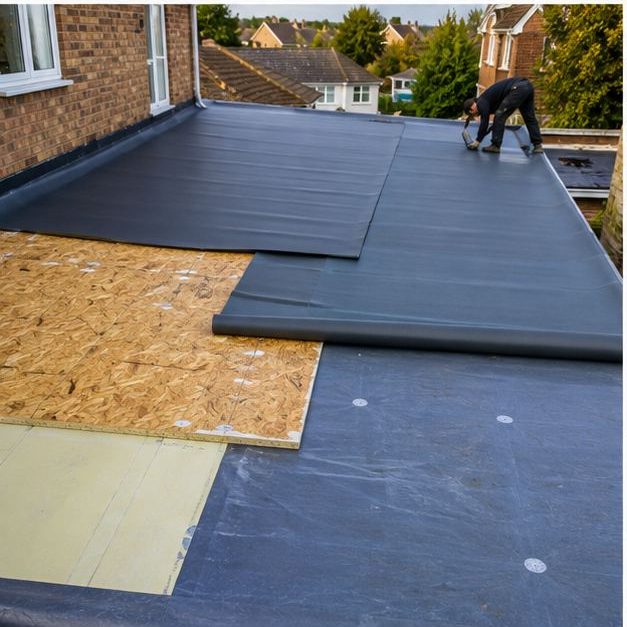
Reading the age of the roof
The first question is what is up there. A thin felt covering on timber boards behaves differently from a rubber membrane or a fibreglass finish. Layers of old patches suggest it has been struggling for some time. We also look at how the roof has been drained. A roof that cannot shed water is going to fail again, whatever material sits on top.
Ask for the reasoning in plain terms. A good assessment tells you what was found, where it was found and why that points towards repair or renewal, so you are never asked to take the answer on trust, and can compare any second opinion fairly against it.
When repair is the right answer
A single leak, a split seam or a failed edge can be mended if the covering around it is still flexible and the deck is firm and dry. That kind of repair is quick, tidy and sensible. It suits roofs that are otherwise flat to the eye, with no deep ponding and no soft spots that give underfoot from below.
- One identifiable fault with sound surroundings
- Deck dry and firm beneath the covering
- Surface still flexible, not crazed or lifting
- Outlets and edges working properly
When it needs replacing
Widespread cracking, blistering across much of the surface, water standing in several places and a spongy deck all point to replacement. Repairing such a roof is only chasing leaks around it. If rain has been getting into the deck for a long time, the boards and insulation may have to be replaced as well. We open a small area to confirm this and show you the condition for yourself.
Garages need a bit of extra thought
Post-war garages are often built with thin walls and shallow falls, and some have older roofing sheets. We check the structure and the support before laying anything new, and we look at how the roof meets the house wall. Where an older material is present, we check what it is before disturbing it and plan the work to suit.
Choosing the new covering
Single-ply rubber suits plain, open shapes, fibreglass copes well with awkward corners, and felt systems still have a place. Choice also depends on how the roof is reached and what is attached to it. We discuss the options and recommend one, and explain our reasons. Planning or Building Regulations checks may apply in some cases, and we advise before work starts.
Frequently Asked Questions
Is it worth repairing a garage roof that is leaking in several places?
Usually not for long. Multiple leaks suggest the covering has reached the end of its useful condition, and a new surface will be a better use of money than repeated patching. We show you where the faults are.
Can a new covering go over the old one?
Sometimes, if the existing deck and covering are dry and sound. Often it is better to strip back, because trapped damp causes trouble later. We look at the roof before recommending either approach.
Will insulation be improved at the same time?
If the roof is stripped, it is a sensible moment to improve insulation and falls. We discuss what suits the building and what the room beneath is used for, so the finished roof is better than the old one.
Talk to our team about flat roofing in Lawrence Weston
Every roof is different — the fastest way to get an accurate answer is a quick chat with our team.