
Heavy rain on an exposed estate arrives sideways as well as down. That is often what finds a gap that ordinary showers miss. Here is how we trace the entry point and what you can check from inside.
If your roof only drips in a downpour, the weather is revealing a gap rather than creating one. Lawrence Weston sits open to the wind from the Severn side, so heavy rain is often driven hard against the roof from one direction, reaching places that gentle rain never touches.
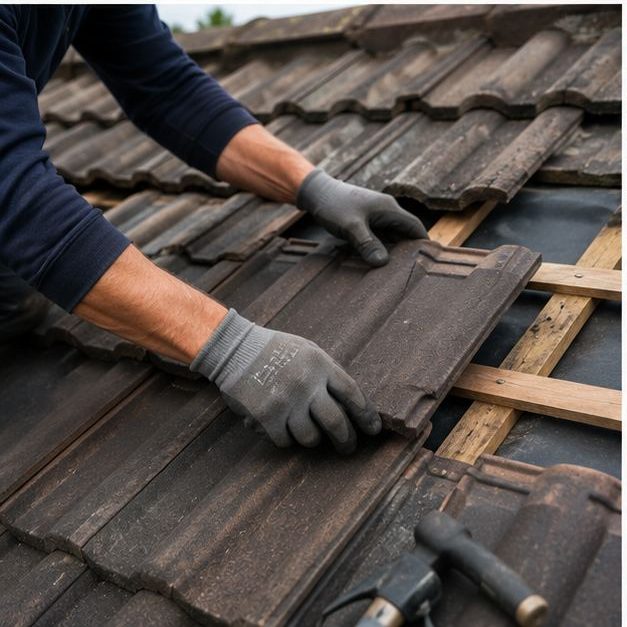
Driven rain behaves differently
Rain in a gale does not simply fall on tiles. It is blown up the slope and underneath the overlaps, where gravity would normally keep it out. Small gaps beside a tile, around a cracked piece or under a lifted edge are suddenly enough. That is why a leak can disappear for weeks and then return in the next big storm. The roof has not repaired itself.
A useful habit is to note the wind direction when a leak appears. If it only shows with the wind in one quarter, that points us to the slope facing it, and saves a lot of searching across the whole roof.
The usual entry points on post-war roofs
Concrete tiles are laid over a felt underlay that has now been in place for many decades. Where tiles have slipped or cracked, or where the felt has torn or perished, wind-driven rain gets through and runs down to the nearest timber. Semis and short terraces also have junctions at chimneys, party walls and the edge of porches or garages where lead or mortar has worn.
- Slipped or cracked concrete tiles
- Perished or torn underlay beneath the tiles
- Failed mortar at the ridge or verge
- Worn lead against a chimney or adjoining roof
Garage and porch roofs
Many houses on these estates have an attached garage or porch, and the roof where it meets the house wall is a regular source of trouble. A flat or low-pitched garage roof, a worn flashing, or a gutter that overflows can all send water into the main house. Staining on an internal wall beside the garage is a clue we always follow up.
Finding the real source
Water travels. It can run a long way along rafters and felt before it appears as a ceiling stain, so the damp patch is not the entry point. We start inside, look for the wet timbers in the loft, and trace the line back up to the covering above. Then we inspect the likely points on the roof itself and explain what we find before anything is done.
What to do in the meantime
Put a bowl under any drip, move belongings away from the wet area and photograph the stain and its date. If you can reach the loft safely, note where the timbers are damp, and whether it is worse in wind or only after long rain. Do not go onto the roof. Call us and we will take a proper look.
Frequently Asked Questions
Why does my roof leak only in strong wind?
Wind pushes rain sideways and upward under tiles, through small gaps that would stay dry in still rain. A leak that appears mainly in gales almost always points to a tile, ridge or verge fault on the windward side.
Could it be the garage roof?
Quite possibly. Where a garage roof joins the main wall, flashing and edge details can fail, and water then tracks into the house. We check both roofs together so the real source is found rather than guessed at.
How quickly should I get it checked?
As soon as you can. Water gets into insulation and timbers silently, and each storm makes it worse. A quick inspection usually finds a straightforward cause, and we tell you honestly if the fix is small.
Talk to our team about roof repairs in Lawrence Weston
Every roof is different — the fastest way to get an accurate answer is a quick chat with our team.