
On many post-war concrete-tiled roofs, a dry verge can replace failing mortar without re-roofing. Compatibility is the key point. Here is what we check and what the work involves.
Falling mortar on a drive or path is often the first sign that a verge is failing. Where the rest of the roof is in decent condition, a dry verge can usually be added to an existing concrete-tiled roof in Lawrence Weston. Whether it suits your tiles is decided on site, not from a catalogue.
The usual starting point
The typical story is a gable on a semi where mortar has cracked, started to crumble and dropped bits onto the garage roof or the path. In strong wind the edge tiles may rattle or lift, which is a warning in itself. That is often when owners ask whether the edge can be fixed without a new roof.
A photograph of the gable taken from the garden, along with a note of where mortar has been landing, gives us a head start. We then confirm everything on site before suggesting the work, including whether the neighbouring gable needs the same treatment.
What has to be checked
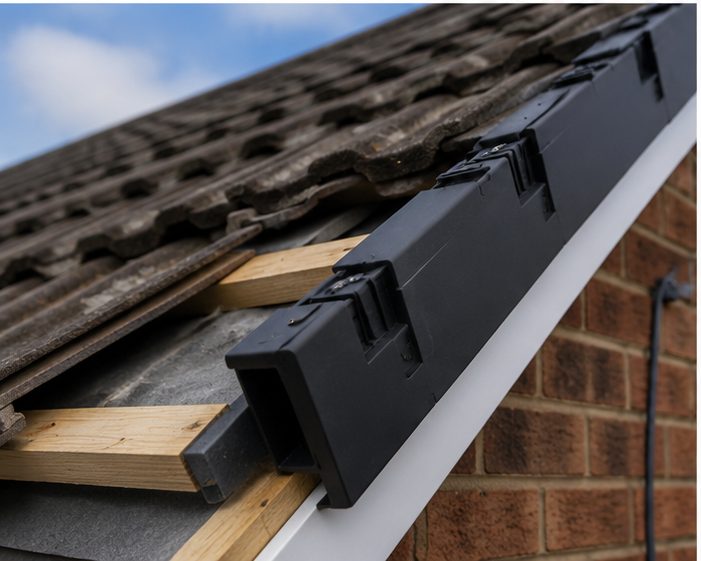
Tile profile comes first. Different concrete tiles have different shapes at the edge, and verge units are designed to fit certain profiles. We identify the tile, compare it with the system and follow the tile maker's fixing guidance. The condition of the edge timbers and battens also matters, since fixings need something sound to hold into.
- Tile profile and edge shape
- Barge timbers and battens beneath
- Underlay at the edge of the roof
- State of the wall top and gable brickwork
How it is done on an existing roof
Old mortar and any loose or broken tiles at the edge are removed. We repair any timber that needs it, then fix the verge units and cap pieces along the gable. Edge tiles are cut or replaced where needed, and the finished run is checked for firmness. The rest of the roof remains as it is, so disruption is limited.
Where it will not help
If tiles across the main slope are slipping, cracked or worn, a new edge does not stop leaks elsewhere. We check the whole roof while we are there, and tell you honestly if the verge is only part of the story. In that case, a broader repair or a different approach may be the better route, and we explain why.
Garages and extensions beside the gable
Many houses here have a garage or side extension tucked against the gable. Access can be tight, and the roof beneath the verge may be a low-pitched garage. We plan the work so that mortar and debris do not fall onto it unseen. A short note of the layout at the side of your house helps us come prepared.
Frequently Asked Questions
Do I need to replace the whole roof to have a dry verge?
No. A dry verge can often be fitted to an existing roof when the rest is in good condition. We check the tile profile and the edge timbers first, and tell you plainly whether it will suit.
What if my tiles are not compatible?
Then we explain the alternatives, which may include re-bedding the verge in mortar or taking a different route at the edge. We would rather tell you now than force a system onto a tile it does not fit.
Will the work be messy?
The old mortar has to come off, so there is some dust and debris, but we clear it as we go and tidy the path and garden when we finish. We also protect the garage roof and drive beneath the gable where we can.
Talk to our team about dry verge systems in Lawrence Weston
Every roof is different — the fastest way to get an accurate answer is a quick chat with our team.