
Walk down any estate road and the eaves look much alike, but each board and channel has its own job. This guide separates them for post-war semis and short terraces, and explains how wind and weather wear them.
The edge of a post-war roof has three jobs to do in a small space. A board faces outward at the rafter ends, a second board closes the underside, and a channel carries the rain away. They are different parts, but on exposed estates they tend to wear out together.
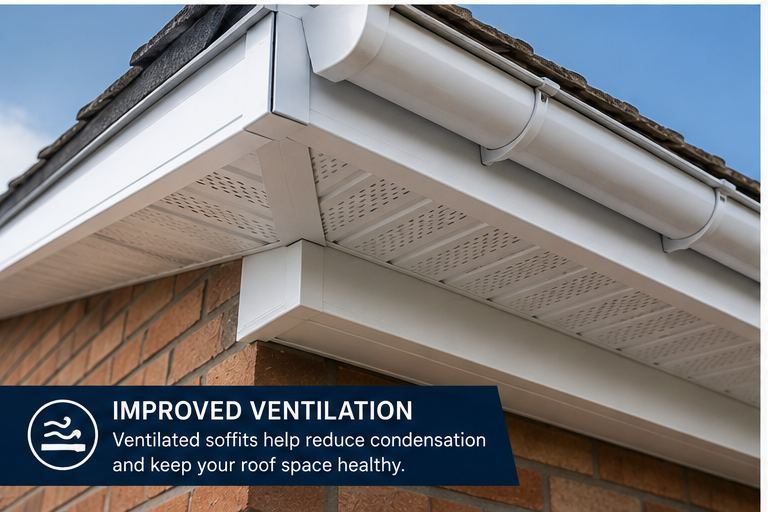
What the fascia does
The fascia is the board that runs along the front of the eaves, fixed to the ends of the rafters. It holds the gutter brackets and gives the roof a neat edge. If it is soft, split or loose, the gutter loses its support and begins to sag. Wind off the Severn side can also work at loose boards, so a fascia that has started to move needs attention.
Short terrace ends and garages add their own lengths of board and gutter, so the total run on a typical plot is longer than it first seems from the front. It is worth walking round the whole house and counting each elevation, including the side of the garage, before you ask for any quote.
What the soffit does
The soffit closes the gap between the wall and the fascia, forming the underside of the overhang. It stops birds, insects and weather getting into the roof space and provides a place for ventilation, either in vented boards or in vent strips. On many semis, the soffit is the first thing to show damage, with sagging boards or holes where birds have found a way in.
- Fascia: board facing outward, carries the gutter
- Soffit: underside board, closes the eaves
- Gutter: channel that carries rain to downpipes
- Bargeboard: board along the gable edge
What the gutter does
Guttering collects water running off the tiles and delivers it to the downpipes. It needs to be level enough to flow, clear of leaves and moss, and sealed at its joints. A blocked or leaking gutter soaks the fascia and the wall beneath. Garages and porches often have their own short runs, which are easy to overlook.
How they depend on each other
A gutter that overflows rots the fascia. A rotten fascia lets the gutter sag. A broken soffit lets in damp air and pests. Because they are fixed together, repairing one often means taking another down, so we look at the whole eaves in one visit. That also keeps access costs sensible, since scaffolding is only needed once.
Spotting problems from the path
Look for flaking paint, dark streaks down the wall, drips from joints, boards that bow and gaps beneath the overhang. In windy weather, listen for rattling. None of this needs a ladder. Tell us what you notice and we will carry out a proper inspection with the right equipment.
Frequently Asked Questions
Are fascias and soffits always UPVC?
Not on older houses. Many post-war homes have timber boards, and some have other materials. We check what is there before disturbing anything and then discuss the replacement, which is often UPVC because it is very low maintenance.
Can guttering be replaced without touching the fascia?
Yes, if the fascia is sound and properly fixed. If the board is rotten or loose, the new gutter will not sit properly. We check the fascia first so the new gutter is not hung on a weak base.
Do garages need the same attention?
They do. A garage often has its own fascia and gutter at lower level, and it is just as exposed to wind. We include it in the assessment, and can match the finish to the house so the whole property looks consistent.
Talk to our team about UPVC fascias and soffits in Lawrence Weston
Every roof is different — the fastest way to get an accurate answer is a quick chat with our team.