
A flat roof is never truly flat. A gentle slope, called the fall, carries water to an outlet, and when it is wrong the covering ages fast. Here is how it works and what we do about it.
Fishponds has plenty of extensions: kitchens off the back of terraces, garages beside semis, small porches and bay tops. Most have a flat roof, and most of the trouble we see on them comes down to one thing, water that has nowhere to go. Slope and drainage matter more than the covering on top.
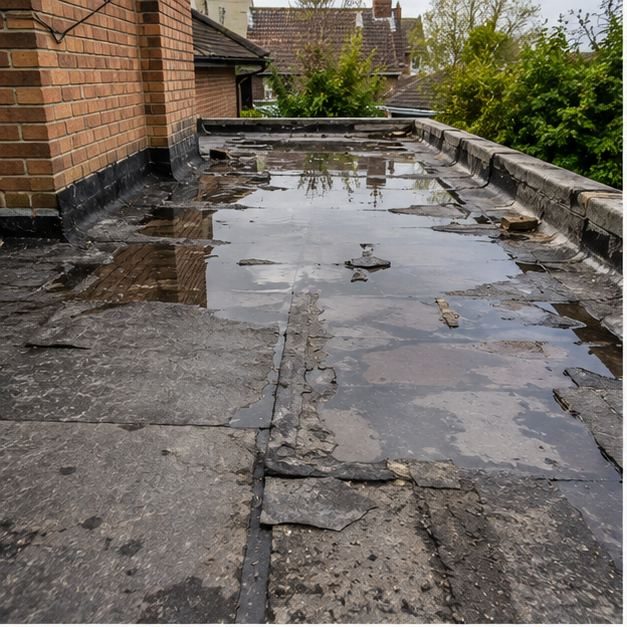
What a fall actually is
The fall is a slight slope built into the deck, usually toward a gutter or outlet, so that rain runs off rather than sitting. It is subtle enough that the roof looks level to the eye. When the fall is too shallow, or has been lost through sagging, water settles in the low spots and stays after the rain has stopped.
Older terrace extensions are often built with a fall to a single point. If a later covering was laid straight over the first, the slope can be flattened out and the low spots deepen, so what looked adequate when new may now hold water for days.
Why standing water is a problem
Water left on a covering works at joints, seams and the edges where the roof meets a wall. It carries dirt and leaves that harden into a film, and in cold weather it freezes and flexes the surface. A puddle that vanishes within a day or so is usually tolerable; one that never leaves is a warning.
Outlets, gutters and blockages
Even a well-built fall fails if the outlet is blocked. Leaves, moss and silt collect at the edge trim, in the gutter and at any downpipe, and the water backs up under the covering. Many extensions have drainage that was an afterthought, so we also check the size and position of the outlet and where it discharges.
- Is the outlet clear and flowing freely?
- Does water leave the whole roof, or only one corner?
- Is the gutter level or sagging in the middle?
- Does the downpipe discharge somewhere sensible?
Putting the fall right
Where the deck is sound, we can add tapered insulation boards or firring strips beneath a new covering to create the slope that was missing. Where timbers have sagged or rotted, the deck is opened up, repaired and re-laid first. We then fit a new covering suited to the roof, with proper edge trims and upstands.
Where a fall cannot be improved, because of a door threshold or a party wall, we plan the drainage around the limit instead, with an additional outlet or a rerouted gutter, and explain plainly what compromise remains in the finished roof. That honesty matters.
What you can watch for
From a window or upstairs room, look at the roof after rain. Pools that last, dark staining at the edge, or damp patches on the ceiling inside all suggest a drainage fault. Keep clear of the roof itself and call us for a proper look, since the repair depends on what lies beneath.
Frequently Asked Questions
Is some ponding normal on a flat roof?
A little dampness after rain is normal. Large puddles that last for days point to poor falls or a blocked outlet. We measure the problem on site and tell you whether a repair or a re-lay is the sensible answer.
Can you add a slope without rebuilding the roof?
Often yes. Tapered insulation or firring strips can create the missing fall under a new covering, provided the deck is sound. If the deck is rotten or badly sagging, it has to be repaired first.
Who should clear a blocked outlet?
Clearing leaves from a flat roof means walking on it, which risks damage and a fall. We clear outlets and gutters safely as part of a visit and look for the cause of the blockage at the same time.
Talk to our team about flat roofing in Fishponds
Every roof is different — the fastest way to get an accurate answer is a quick chat with our team.