
A stain on the ceiling is where the water arrived, not always where it got in. Tracing a flat roof leak means working methodically from the inside, then the surface, then the details.
A leak under a flat roof can be maddening, because the covering often looks perfectly intact. In Fishponds, where so many homes have had a kitchen or garage extension added, we see this regularly. The answer is rarely a guess; it comes from a set order of checks.
Start inside
We begin with the room below. Where is the stain, does it spread after rain or only in a strong wind, and has the ceiling sagged? Then, if there is access, we look at the deck from beneath. Water follows the lowest route, so the damp patch can sit well away from the hole, which is why we never just patch above the stain.
It helps if you can tell us when it drips: during rain, hours afterwards, after a dry spell, or only with wind from a certain direction. Those clues narrow the search a great deal before anyone goes up to look at the roof itself.
Then the surface
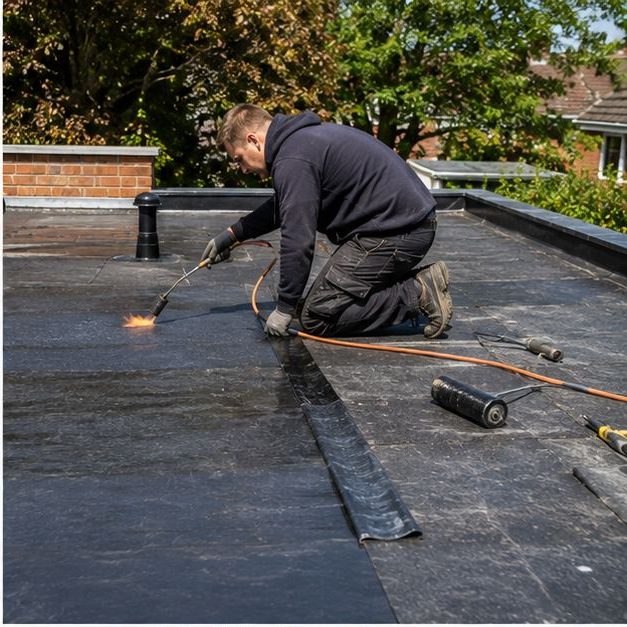
On the roof we look at how the covering lies. Cracks and splits, blisters, lifted seams, worn patches and old repair patches are the usual suspects. A roof that has been repaired many times often has water trapped between layers, so a visible fault is not always the entry point.
We also test drainage by checking whether water leaves the roof freely, since a blocked outlet can force water under laps and into a seam that would otherwise stay dry, and that explains leaks that appear only after heavy or prolonged rain.
The details where most leaks start
Most flat roof leaks begin at the details rather than across the open surface. We study the junctions where the roof meets a wall, the edge trims, rooflights, vents and any pipe that passes through. These are the spots where movement and weather work hardest, and where the covering has to be cut and sealed by hand.
- Upstands and abutments against house walls
- Edge trims and drip details at the gutter
- Outlets, vents and pipes through the covering
- Seams, laps and old patch repairs
What the fix looks like
If the covering is sound apart from one failed joint or split, a proper repair with compatible material is sensible and sensibly priced for the problem. If the deck is soft or insulation is saturated, the wet material has to come out. We tell you which applies after opening up, not before, because the underside decides the answer.
When replacement is the honest answer
Where faults are widespread, with repeated cracks, wet insulation or a rotten deck, repairing again is poor value. We recommend replacing the covering, with a new fall and edge details where needed. It is not the answer every time, and we say so plainly when a repair will do.
Frequently Asked Questions
Why is the leak in a different place to the stain?
Water runs along the deck, insulation and joists before it drips through. The ceiling mark may be a metre or more from the real opening, so we trace back from the stain to the source.
Can a flat roof be repaired while it is wet?
Not properly. Coverings need a dry, clean surface to bond or seal, so we may protect the area temporarily and finish the repair when conditions allow. We tell you what the temporary measure does and does not do.
Is a patch a permanent fix?
A patch is a good repair where the surrounding covering is sound. If the roof is failing across its area, a patch only delays the next leak, and we advise replacement in that case.
Talk to our team about flat roofing in Fishponds
Every roof is different — the fastest way to get an accurate answer is a quick chat with our team.