
Flat roof leaks rarely show up where the water gets in. This is how we trace the source on extensions and outbuildings, and how we decide between a repair and a new covering.
A drip on the ceiling of a flat-roofed extension tells you water is getting in, but not where. The covering, the deck and the insulation all carry water sideways before it appears. In Barton Hill, with so many extensions and outbuildings added to older houses, we trace leaks regularly. It is a process of elimination, working from the likeliest weak points outwards.
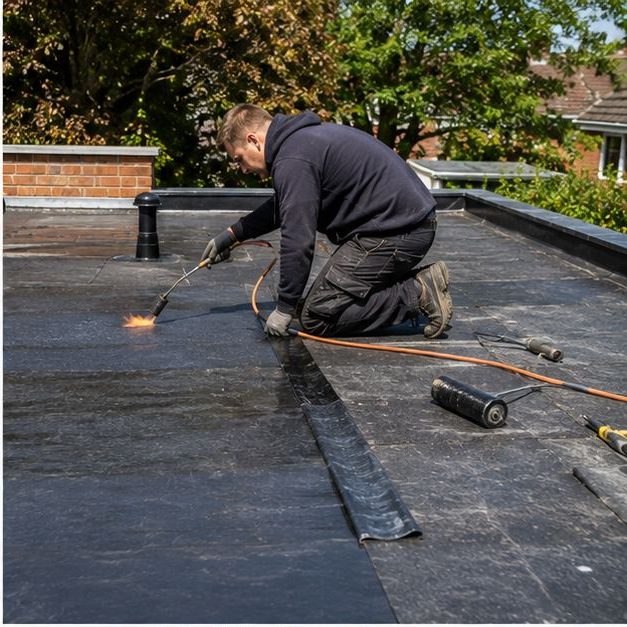
Start with the inside
We look at the ceiling below, noting where the stain is, whether it grows after rain only or all the time, and whether the timber above feels damp. That pattern helps narrow the search. A leak that only appears in strong wind suggests a joint or upstand, while one that follows any rain points to a wider fault.
Keep a note of when the drip appears and how heavy it is. That detail, together with the position of the stain on the ceiling, saves time when tracing and helps us decide where to look first when we get on site.
Where flat roofs usually fail
Most leaks start at details rather than the open surface. We check where the roof meets a wall, the upstands, edge trims, rooflight kerbs, pipe penetrations and outlets. Then we look for blisters, cracks and splits in the covering itself. A tiny opening at a joint can let in a surprising amount of water.
- Joints and laps where sheets or strips meet
- Upstands and the junction with the house wall
- Edge trims and drip details at the gutter
- Outlets and gutters that hold water back
Finding the real entry point
Water can run along the deck and insulation for some distance. We therefore trace from the stain back along the likely path, checking each detail in turn. Sometimes the cause is plain once we are up there, such as a split or a lifted edge. Other times we need to open a small area to see what is under the covering.
We take photographs as we go so you can see what we found and why we are recommending a particular repair, rather than just taking our word for it. That also gives you a record of the roof as it was before the work.
Repair where the roof is sound
If the covering is mostly in good order and the deck is dry, a local repair makes sense. That might mean replacing a section, resealing an upstand, refitting an edge trim or clearing an outlet. We dry out and check the material below first, because sealing over wet insulation just traps the problem.
When a repair is not enough
Widespread cracking, soft or rotten deck, multiple failed joints and repeated leaks in different places all point towards replacement. We would rather tell you that plainly than patch a roof that will fail again. A new covering also lets us correct falls and insulation. We explain the options in writing before we start.
Keep a note of any new stains and the weather when they appeared. That small record helps us a great deal on a return visit, and it often points straight to the part of the roof that needs another look.
Frequently Asked Questions
Can you find a flat roof leak without stripping it?
Often, yes. We work from inside and out, checking the likeliest details first. Occasionally we open a small area to confirm the source, and we make that good as part of the repair.
Why does my ceiling stain keep coming back?
Usually the original entry point was never fixed, or wet insulation is still releasing moisture. A repair that only treats the visible patch can miss the real cause. Tracing the full path of the water is the answer.
What materials are used for flat roof repairs?
It depends on what is already there and what condition it is in. Common options are single-ply rubber, fibreglass and felt systems. We choose to suit the existing roof and explain why before work begins.
Talk to our team about flat roofing in Barton Hill
Every roof is different — the fastest way to get an accurate answer is a quick chat with our team.