
Finding where a flat roof leaks takes patience, because water runs along the deck before it drips. Here is how we trace the fault and what the fix usually involves.
Flat roofs turn up all over Filton, over garages, porches, bays and rear extensions added to inter-war and post-war houses. When one leaks, the stain inside is only the end of the story. We follow the water back to the real source, then decide on the neatest repair that will last.
Starting inside
We begin with the ceiling, noting the shape and position of stains, whether they grow in rain, and whether they appear near walls, outlets or the middle of the roof. A stain beside a wall suggests the upstand; one under a rooflight suggests its kerb. Looking inside tells us where to start looking on the roof. It also tells us whether the leak is likely to be one defect or several.
Reading the roof surface
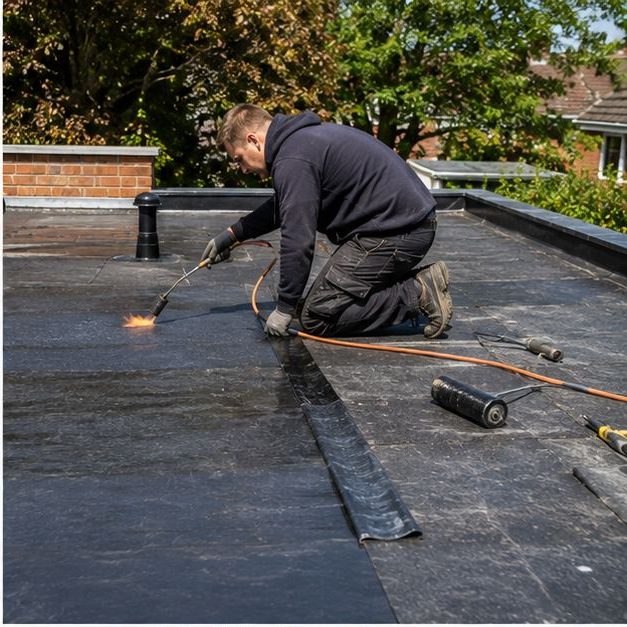
On the roof we look for splits, blisters, lifted laps and failed joints. We check the edges and trims where the covering finishes, the upstands where it meets walls, and the outlets where water leaves. Ponding patches show where the falls are poor or the deck has dipped. We press the surface lightly where we suspect soft deck. Ponding marks often show where a leak has been going on for some time.
- Cracks and splits in the covering surface
- Open laps or joints between sheets
- Lifted or loose edge trims and drips
- Blocked or poorly sealed water outlets
Following the water
Water often enters at one point and travels along the deck or insulation before it falls. We trace back from the stain towards the likeliest joint, edge or penetration, and where needed lift a small area to see what lies beneath. Finding the true source avoids covering a defect with a patch that fails next month.
Fixing it
Where the covering is otherwise sound, we cut out the damaged section and form a new patch or joint with the same system, properly lapped and secured. Edges, upstands and flashings are renewed where they have failed. If the deck has been wet and softened, the damaged board is cut out and replaced first. We show you what we find, so the repair makes sense to you.
When a repair is not enough
If the surface is failing widely, the deck is soft in several places or water is spread through the insulation, patching only delays the problem. We say so plainly and explain the alternatives, whether single-ply rubber, fibreglass or felt, and what each involves. Renewal may need planning or Building Regulations checks — we advise before work starts.
Keep a note of any new stains and the weather when they appeared. That small record helps us a great deal on a return visit, and it often points straight to the part of the roof that needs another look.
Frequently Asked Questions
Can a flat roof leak be found without opening it up?
Often the cause shows from the surface and the edges. Sometimes we need to lift a small area to see how far water has travelled. We keep this to the minimum needed to find the real fault.
Why does my flat roof leak in some rain and not others?
Wind direction and rain volume decide whether water reaches a weak joint or edge. Standing water also finds defects that run-off does not. Noting when it leaks helps us narrow down the cause.
Is a bitumen-style coating a lasting fix?
A coating can slow a small leak for a short time but does not mend a split joint or a rotten deck. A lasting repair deals with the cause, using materials matched to the existing system.
Talk to our team about flat roofing in Filton
Every roof is different — the fastest way to get an accurate answer is a quick chat with our team.