
Tiles rarely slip or crack for no reason. In Filton the causes run from worn fixings on older roofs to knocks and movement on newer ones, and each points to a different repair.
Walk down a wide Filton street and you will see roof after roof of hipped tiles, from inter-war houses to post-war and modern infill. Look closely and a few tiles sit crooked or show a crack. Those small signs have causes worth understanding, because the cause decides whether a quick repair will hold.
Fixings that have given up
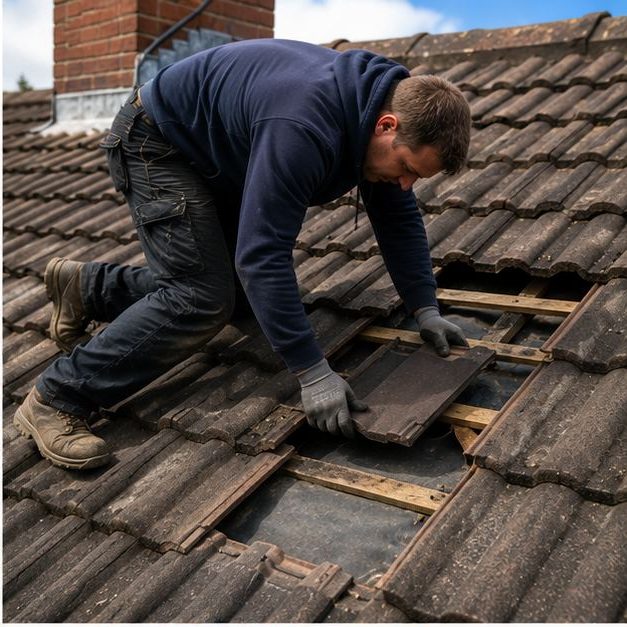
Tiles are held by nails, clips or the weight of their own lap. On older roofs the nails corrode and the tile loosens, then slides a little with every gust. On inter-war and post-war roofs this is among the commonest reasons for a slipped tile, and it often affects a whole area, not just one tile that has moved. Photos taken from the garden give us a useful starting point.
Wind and storm loading
Hipped roofs have long hip lines and exposed corners where wind lifts and rattles tiles. A gust can shift a tile just enough to break its lap, and the next shower finds the gap. After a storm you may see tiles resting on the gutter or lying in the garden. Wide streets and open gardens leave many roofs without much shelter.
- Tiles that have shifted down the slope
- Tiles resting on or fallen into the gutter
- Gaps along hips and ridge lines
- Fragments of tile on paths or lawns
Frost, age and weathering
Old clay and concrete tiles absorb water. When the water freezes it expands and flakes the surface or cracks the tile through. Moss holds moisture against the tile and makes this worse. Age alone does not condemn a tile, but a roof with many flaking or cracked tiles may be reaching the point where repair gives way to renewal.
Knocks, movement and foot traffic
Tiles also crack when someone has walked on the roof, when an aerial or satellite dish has been fitted, or when branches have fallen across them. Timber movement in an older house can also loosen the covering. We look at how the damage is spread, because a scatter of single tiles suggests knocks, while a patch suggests fixings.
What we check and what we do
We look at the roof from the ground and at close range, then in the loft for daylight, damp timbers and stained felt. Slipped tiles are refixed with proper fixings, cracked ones replaced to match, and the underlay checked beneath. If the whole roof is tired, we say so and explain the choices. We would rather fix the cause than keep replacing tiles one at a time.
Frequently Asked Questions
Is a slipped tile urgent?
It lets water in, so it should not be left through a wet spell. A single slipped tile is usually a quick job. If you can see one from the ground, note where it is and call us rather than going up to look. The longer water gets in, the more damp reaches the timbers.
Can a cracked tile be repaired rather than replaced?
Sealant does not make a cracked tile sound. The reliable fix is to replace the tile with a matching one and check the underlay beneath. Where the roof is old, finding a good match is part of the job.
Why do tiles slip again after a repair?
Usually because the fixings around the repair are also worn, so neighbouring tiles move next. A proper repair looks at the surrounding area and refixes where needed, rather than treating one tile alone.
Talk to our team about roof repairs in Filton
Every roof is different — the fastest way to get an accurate answer is a quick chat with our team.