
Replacing fascias and soffits is more than swapping boards. Here is the sequence on a typical Filton house, from access and stripping to venting and gutters.
Filton has many inter-war and post-war houses with hipped roofs, where the eaves run all the way round the house. That means a lot of board, and a lot of corners. Replacing fascias and soffits is a job done in stages, and knowing the stages helps you judge a quote and plan for the work.
Access first
The work sits at the eaves, so safe access is needed. That usually means scaffold or a proper platform, especially on a hipped roof with a long run of boards and several corners. Wide streets and driveways help, but the access still has to be planned so the work is done safely and with minimal disruption.
A fair quote also describes how waste will be taken away and how the garden and drive will be protected while boards are lifted. Those practical details say a lot about how tidy the job will be, and a roofer who has thought about them in advance usually works carefully on the parts you cannot see.
Stripping out
The old gutters come off first, then the fascias, bargeboards and soffits. On older houses we check what the existing soffit boards are made of before we disturb them, so the work proceeds the right way. Once the boards are off, the rafter ends and eaves are exposed for inspection.
- Gutters and brackets removed carefully
- Old fascia and soffit boards taken off
- Rafter ends and eaves examined
- Debris and old fixings cleared away
Checking what lies behind
This is the most important stage. Rafter ends that are damp, soft or marked need attention before new boards go on. Eaves may hold nests or old insulation that blocks airflow. We tell you what we find, and if repairs are needed they are agreed before we carry on. New boards over bad timber only hide a problem. Birds nest in eaves, and old insulation or debris can block the airflow, so we clear it as part of the job.
New boards and ventilation
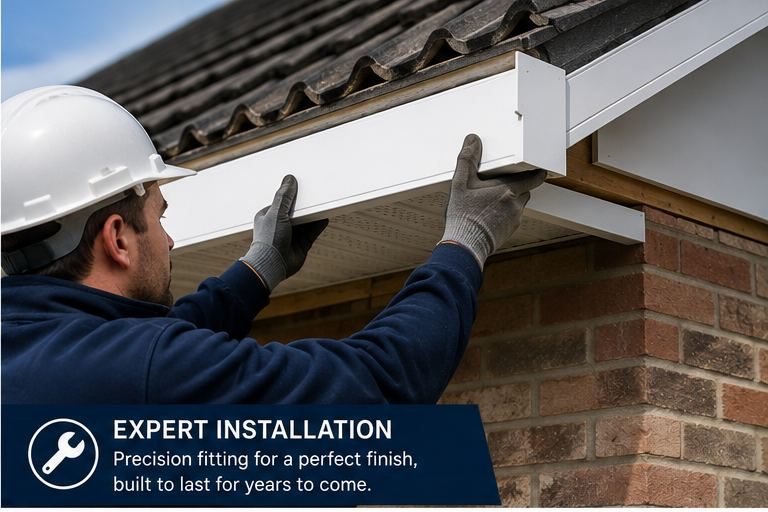
New fascias and soffits are fixed square and level, with vented soffits or vent strips so air can move into the roof space. Finishes include white, darker and wood-effect options. UPVC is very low maintenance, and is cleaned rather than painted. Corners and joints are made neat and tight. Joints at the hips and corners are cut to fit tight, so the line reads clean from the street.
Gutters and finishing
Gutters are refitted or replaced, set to a fall so water reaches the downpipes, and checked for leaks at joints. We clear the site and check the line from the ground. Work may need planning or Building Regulations checks — we advise before work starts. Each stage is explained before the next one begins.
Frequently Asked Questions
Can fascias be replaced without touching the gutters?
Not really. The gutters hang from the fascia, so they have to be taken off. Sound gutters can be refitted, but if they are cracked or badly jointed it makes sense to renew them.
Will the job make a mess?
Some dust and debris are unavoidable, but a tidy team clears as it goes. Access will be set up around the house, and we explain beforehand where it goes and how long it stays up.
Do I need vented soffits?
Venting lets the roof space breathe and cuts condensation, so we fit vented soffits or vent strips as standard. The right arrangement depends on the roof, which we check as the old boards come off.
Talk to our team about UPVC fascias and soffits in Filton
Every roof is different — the fastest way to get an accurate answer is a quick chat with our team.