
Flat roofs hide their faults under a continuous covering. Finding the real entry point takes method, and that is what decides whether a repair lasts.
Garages, rear extensions and porches on Hillfields semis and short terraces often carry flat roofs, and leaks from them are rarely where the stain appears. Tracing one is a step-by-step job. This guide walks through how we find the entry point, what the usual faults are, and how each is fixed, so you know what a proper repair involves.
Starting from the inside
We look at the ceiling and walls below for the pattern of staining, and note where it began. In a garage or porch, we also look at the deck underside if it can be seen. Water often travels along joists or the deck before it drips, so the mark inside is only a clue to the area, not the exact point. A few minutes spent here saves guesswork later.
Reading the surface
Next we inspect the covering for blisters, cracks, splits, open joints and sunken areas where water sits. Ponding is a flag in itself, since standing water finds any weakness. We check outlets for blockage and look for debris, moss or tree fall that stops water draining. On garage roofs the covering may have been patched before, and old patches can be the very fault we are looking for.
- Splits and cracks along seams
- Blistered areas with trapped moisture
- Ponding where water cannot escape
- Blocked or poorly formed outlets
The details at the edges
Most leaks start at junctions, not in the middle. We look at upstands where the roof meets the house wall, edge trims, and any flashings or penetrations. A missing cover strip or lifted trim lets water behind the covering. These are checked carefully before we trust the middle of the roof.
Fixing what we find
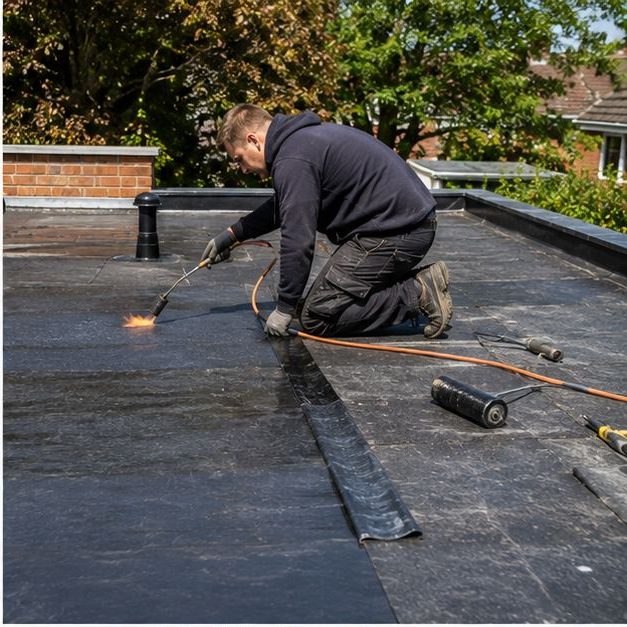
Where damage is local, we cut out the failed section, dry the deck, and patch or re-form the joint with a compatible material. Upstands are refixed and trims renewed. If the deck is soft or the covering is failing widely, we explain that replacement is the sensible route, with sound decking, correct falls and a new system such as rubber, fibreglass or felt. Dry material is essential before anything is stuck down.
- Local repair to one split or joint
- Reforming upstands and edge trims
- Clearing and correcting outlets so rain can drain away freely
- Replacing the deck where it has rotted
What to expect and ask
Ask where the water was getting in and how that was confirmed. A good answer is specific. Expect a clear explanation of repair versus replace, and tidy working. Do not climb onto the roof to look yourself. Where work may need planning or Building Regulations checks, we advise before work starts.
Frequently Asked Questions
Can I find the leak by pouring water on the roof?
That is a method roofers use carefully, section by section, but it is not something to try at home. Water on a damaged flat roof can make damage worse inside. Photograph the stain and let us trace it properly.
Why does the leak come back after a patch?
Often the patch covered the symptom, not the source, or the surrounding covering is failing. A repair that holds needs the entry point found and the area around it sound enough to take the fix.
Do garage roofs get repaired the same way as extension roofs?
The method is the same, but garage roofs often have simpler decks and fewer details, while extension roofs have more junctions with the house. We adapt the repair to the roof in front of us.
Talk to our team about flat roofing in Hillfields
Every roof is different — the fastest way to get an accurate answer is a quick chat with our team.