
Tiles do not slip for no reason. On a hillside suburb of semis and short terraces, wind, ageing fixings and small movements in the roof usually explain it.
A tile sitting out of line or a cracked one lying in the garden is a symptom, not the whole story. In Hillfields the houses are inter-war and post-war semis and short terraces on a hill, so roofs catch the weather and have had decades to loosen. This guide covers the usual causes, what we check, and how slipped or cracked tiles are put right.
Wind on a hillside
A roof on rising ground takes more of the wind than one tucked in a hollow. Gusts lift the edges of tiles, working them loose a fraction each time. Over many storms a tile that was once snug slides down or turns, and the gap lets rain reach the felt. Roof edges, hips and ridges are the first places to show it.
Ageing nails, clips and battens
Tiles are held by nibs on the batten, and often by nails or clips as well. On inter-war and post-war roofs, iron fixings corrode, battens soften and dry, and the grip fades. A tile then slips with very little push. Where one has moved, its neighbours are often close behind, so we check the slope around it, not only the single tile.
- Rusted or snapped nails and clips
- Battens that have softened or split
- Felt that has worn thin under the tile
- Mortar bedding that has dried and shrunk
Why tiles crack
Tiles crack for several reasons: frost working into a porous tile, a heavy footstep from someone who should not have been up there, a branch or debris landing on it, or thermal movement over a long run. Concrete tiles can lose surface and thin out. Cracks are easy to miss from below, so we look closely along the line of any stain indoors.
What you can check without going up
From the garden or street, look for tiles that sit out of line, dark gaps, pieces on the ground or in the gutter, and mossy patches where water lingers. Binoculars help. In the loft, look for daylight where the covering should be tight, and damp felt or timbers below. Please do not climb up or use a ladder. Photograph what you can and call us for a proper look.
- Missing or tilted tiles in the roof line
- Fragments of tile in the gutter or garden
- Light showing through the covering from the loft
How we repair them
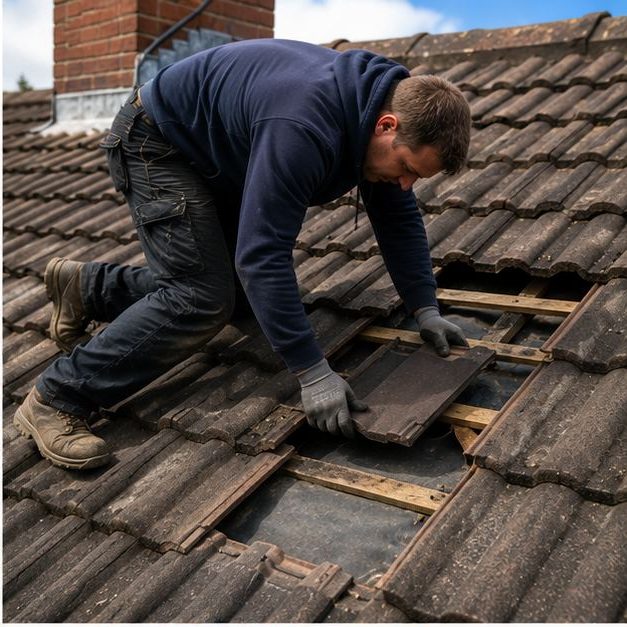
We replace slipped and cracked tiles with close matches, refix loose ones with the right clips or nails, and check the felt and battens beneath. On semis and terraces we also look at the neighbouring slope and shared details, so a quick fix does not hide a wider problem. If the roof is tired overall, we say so plainly.
Frequently Asked Questions
Can a single cracked tile cause a leak?
Yes, if it lets water onto the felt, especially in heavy or wind-driven rain. The felt may cope for a while, then wear through. That is why even one broken tile is worth replacing early.
Why do tiles slip even when the roof looks sound?
Fixings and battens can fail unseen. A roof may look straight from the street while the nails below have rusted. Wind on higher ground then moves tiles a little at a time until one finally drops.
Should I replace tiles myself if they are just lying in the garden?
No. Putting a tile back means working on the roof, which is unsafe without proper access and edge protection. Keep the fallen tile, take photographs and ask us for a look so the cause is dealt with too.
Talk to our team about roof repairs in Hillfields
Every roof is different — the fastest way to get an accurate answer is a quick chat with our team.