
Water on a flat roof can travel a surprising distance before it shows indoors. Tracing it means working outwards from the stain and testing the likely weak points one by one.
A drip on a ceiling in Redcliffe is rarely directly below the hole. Water runs along the deck, along the underside of insulation and down a wall before it appears. Fixing the wrong spot just delays the next stain. A good trace is methodical and starts well before anything is cut or covered.
Reading the evidence inside
We start in the room. Where is the stain, how old is it, and does it grow after rain or all the time? A stain that spreads in dry weather may be condensation or a leaking pipe rather than the roof. Photos, dates and any pattern you have noticed help us narrow the search before we go up to the roof.
The usual weak points outside
On parapet and flat-topped buildings the leaks tend to hide at the details, not in the open surface. We study each of them in turn, looking for splits, lifting edges and failed sealant. The covering across the middle of the roof is often perfectly sound.
- Upstands and junctions where roof meets a wall or parapet
- Joints and laps in the covering
- Roof lights, vents and pipe penetrations
- Edge trims and outlets that no longer seal
Testing rather than guessing
Where the cause is not obvious, we isolate sections and check them one at a time, sometimes wetting small areas to see what happens inside. It takes patience, but it avoids covering over a roof that was only leaking at one joint. On crowded sites we also check where neighbouring work or runoff may be adding water.
Where several roofs sit side by side, as they do in warehouse conversions and rear extensions, runoff from a neighbouring surface can also feed a leak. We look at what drains onto the roof as well as the roof itself. That matters on crowded city sites.
Repair where it is sound enough
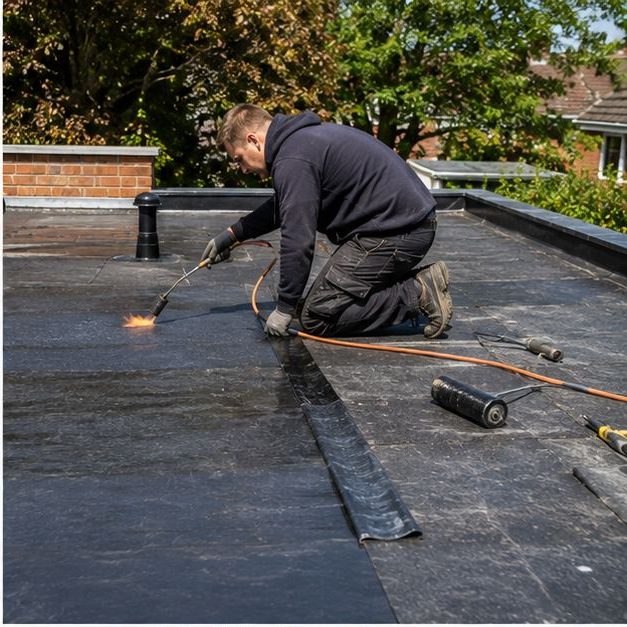
If the covering is generally healthy, a local repair is honest and sensible: a patch, a renewed joint, a resealed upstand or a replaced outlet. We make sure the surface is clean and dry, use materials compatible with what is there, and explain what has been done so you can spot any recurrence early.
When replacement is the right answer
If water has soaked the insulation, the deck is soft, or the surface is split in many places, patching only chases the leak around the roof. We then recommend stripping back, replacing damaged deck, laying proper falls and fitting a new covering such as single-ply, fibreglass or a felt system, explaining the choice plainly.
Whichever way it goes, you should get a plain written description of the proposed work before anything starts. It should say what the cause was, what is being done about it, how we will reach the roof on a tight site and what will be tidied away afterwards.
Frequently Asked Questions
Can a leaking flat roof be repaired in wet weather?
Temporary measures are often possible, but lasting repairs need a dry, clean surface to bond to. We make the roof safe for the time being and carry out the proper repair once conditions allow, so it is not done twice.
How do I know if the deck is damaged?
From inside, a sagging ceiling, soft board or a musty smell hint at it. Confirming it needs a look at the roof itself, because wet insulation and rotten deck only show once the covering is opened.
Does a leak always mean the whole roof must go?
No. Many leaks come from a single joint or upstand and a targeted repair is perfectly reasonable. Replacement is for roofs where damage is widespread or the structure beneath has been affected, and we explain the evidence either way before you decide.
Talk to our team about flat roofing in Redcliffe
Every roof is different — the fastest way to get an accurate answer is a quick chat with our team.