
Replacing fascias and soffits is a sequence of stages more than a single task. Access comes first, then removal, checks at the eaves, fitting, ventilation and finally the gutters.
On the terraced streets of Redcliffe, space is limited and the eaves can be close to neighbours. That shapes how the work is planned. Here is what happens from the first visit through to the last gutter bracket, so you know what to expect and what to ask any roofer.
Planning the access
Every fascia job begins with how we reach the eaves safely. On a tight site that may mean a scaffold across the front or a tower in a narrow yard. We look at the pavement, the neighbours and any parked vehicles before settling on a method, and we explain how long the access will be in place.
Pavement use, neighbours' windows and shared walls are all considered before anything is ordered. We tell you roughly when the scaffold goes up and comes down, and what arrangements are needed for parked vehicles or shared passages so nobody is caught out.
Taking the old boards and gutters away
The gutters come off first, then the old fascia, soffit and any bargeboard. On older houses we check what the existing soffit boards are made of before we disturb them, and handle them accordingly. Debris is collected as it comes down rather than dropped, which matters when the street is narrow.
Checking what is behind the boards
With the boards off, the rafter ends and eaves are exposed. Rot, woodworm or old water damage is visible now and can be dealt with before anything new is fixed. This is the reason a quote from the ground alone has limits, and why a sensible roofer will say that extra work might be found.
- Condition of the rafter ends and wall plate
- Gaps where birds or insects could enter
- Old felt or eaves protection that has perished
- Fixings and packing that need replacing
Fitting the new boards and ventilation
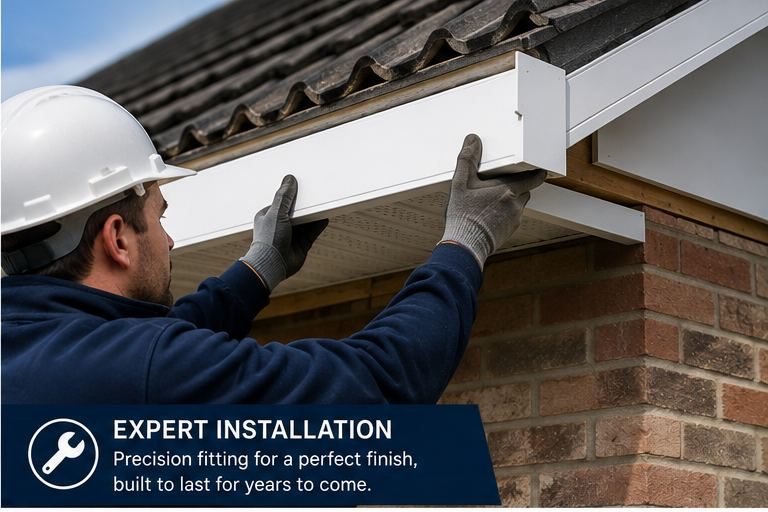
New UPVC fascia, soffit and bargeboards are fixed straight and neat, in white or a darker or wood-effect finish. Vented soffits or vent strips are included so the roof space can breathe. Joints are tidy and the finish needs only an occasional wash, being very low maintenance.
We also look at how the roof edge meets the wall, so that the new boards sit tight and close the small gaps that let in driving rain, draughts or nesting birds. Neat detailing at the corners and joints is what makes the finished eaves look right from the street.
Gutters and clear-up
Gutters are refitted if sound or replaced if worn, and set to a gentle fall towards the downpipes. We test the run, tidy the site and remove waste. Ask for the work in writing so that the boards, ventilation and gutters are all clearly described. Planning checks are only occasionally needed, and we advise before work starts.
Frequently Asked Questions
Will I need to be at home while the work is done?
Not usually, though access to the front or a yard may be needed. We agree arrangements beforehand, and tell you if we need to enter the property to check the loft or eaves.
Does the whole roof edge have to be done at once?
Not necessarily. Some owners renew one elevation and leave the rest, but doing all of it together saves repeated scaffold and gives one matching finish along the whole roof edge. We can talk through sensible phasing if budget or access makes that better.
What if rot is found behind the old boards?
We stop, show you and explain the options. Damaged rafter ends can often be repaired or strengthened before the new boards are fixed. It is far better to find it now, while the eaves are open, than to cover it up.
Talk to our team about UPVC fascias and soffits in Redcliffe
Every roof is different — the fastest way to get an accurate answer is a quick chat with our team.