
Garage roofs are a feature of the estates around Bishopsworth, and replacing one follows a clear order. Here is what happens from first visit to final edge trim.
Many houses on the inter-war and post-war estates here have a garage beside or behind them, and the flat roof on top often outlasts its usefulness quietly. Replacing it is a manageable job with a sensible order: strip, repair the deck, set the falls, lay the covering, finish the edges. Cutting corners at any step shows up later.
The survey
We look at the garage from inside and out. Inside, we note stains, daylight and any sag. Outside, we check the covering, the edges, the gutter and the junction with the house wall. Exposed sites mean the edges take a battering from wind, so we pay attention to how the roof is held down at the perimeter. A short survey saves surprises later.
Removing the old covering
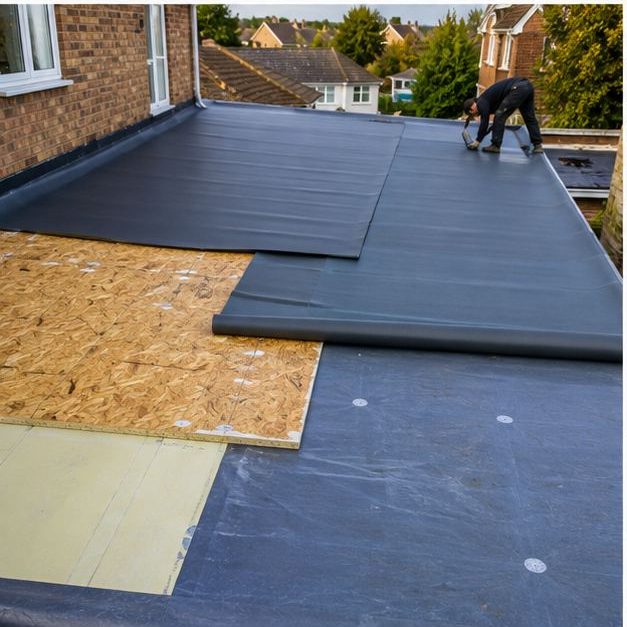
The old covering is lifted off and taken away, down to the deck. Sometimes there are several layers. We then see what condition the boards are in. Damp or rotten sections are cut out and replaced with sound timber, and the deck is dried and made flat. Skipping this step is how new roofs end up failing early. Take photographs of the exposed deck so you can see it too.
- Old layers removed and taken away.
- Rotten boards cut out and renewed.
- Joists and fixings checked for movement.
- Deck cleaned and dried before covering.
Falls and insulation
Water has to run off. We set the deck so it falls towards the gutter or outlet, using firring strips where necessary. If the garage is warm, used as a workshop or attached to living space, insulation can be added. This is the easiest moment to do it, and we explain how it affects the thickness and the edge details. We agree the choice with you before ordering.
The new covering and edges
The usual systems are single-ply rubber, fibreglass or felt. Each has strengths, and we talk through them for your roof without pushing a favourite. The edges are finished with proper trims, upstands are formed where the roof meets the wall, and flashing seals the top. Wind is a factor here, so the fixing and edges are given careful attention. The details at the edges matter as much as the main sheet.
Before and after
Move vehicles and valuables ahead of the work. We protect what remains and clear up afterwards. Ask for a written description, including what happens if the deck proves worse than expected. Larger changes may need planning or Building Regulations checks — we advise before work starts. You should know the plan before the old roof comes off. We explain each stage. Ask who will be on site and when.
Frequently Asked Questions
Can I keep my car in the garage during the work?
It is better to move it, because debris falls and the roof is open while the old covering is off. We plan around the weather and protect the contents we can, but an empty garage is safest. Moving valuables out beforehand is sensible.
Will the garage roof leak less afterwards?
A properly laid new roof with sound falls and sealed edges should keep water out. Leaks often come from edges and junctions, so these get as much care as the main surface. A tidy, sealed finish is the aim.
Is it worth adding insulation?
If the garage is used as a workshop, a store for sensitive items or a room, yes. For a plain car port, it matters less. We talk it through before deciding on the build-up. We explain the options before starting.
Talk to our team about flat roofing in Bishopsworth
Every roof is different — the fastest way to get an accurate answer is a quick chat with our team.