
Vents in the soffit are small, but they keep the roof space dry. Here is why they matter on Bishopsworth semis and what we do when new fascias and soffits go on.
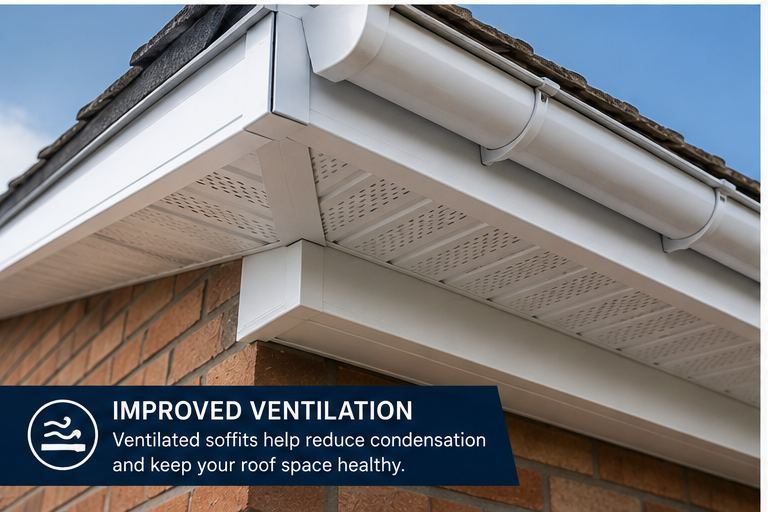
The soffit closes the underside of the eaves, and a vented one lets air pass into the roof space. That air carries away the moisture a family produces every day. Without it, damp collects under the tiles, the felt sweats and timbers slowly suffer. On hipped roofs with deep eaves, the boards offer plenty of room for ventilation.
Where the moisture comes from
Cooking, showers, laundry and simply breathing put water vapour into the air, and warm air drifts upwards into the loft. Inter-war and post-war semis often have loft insulation topped up over the decades, which keeps the roof space colder and gives that vapour more reason to condense. Fresh air moving through the space stops it settling. A dry roof space is simpler to look after than a damp one.
How the airflow works
Air comes in through vents at the eaves, passes beneath the roof covering and escapes at a high point such as the ridge. This gentle movement happens without fans or switches, driven by wind and temperature. On higher, open ground like this, wind helps the flow, which is a small advantage as long as the inlets are not blocked.
- Inlet vents at the soffit let fresh air in.
- Air passes along the underside of the roof.
- High-level vents let damp air leave.
- Insulation must not block the gap at the eaves.
What goes wrong without vents
Solid soffits and loft insulation pushed hard into the eaves can choke the airflow. Over time the felt turns damp, timbers go dark, nails rust and the roof space smells musty. Rafter ends and wall plates are at risk of rot. Damp can also travel to the fascia, which makes it rot from behind as well as outside. The damage is slow, which is why it is often found late.
- Musty smell when the loft hatch opens.
- Dark speckling on rafters or boarding.
- Wet insulation near the eaves.
- Rot spreading from the soffit to the fascia.
Fitting vented soffits
When we replace the boards, we remove the old fascias, soffits and gutters, check the rafter ends and eaves, then fit new boards with vented soffits or vent strips. Insulation is kept back from the opening. Gutters are refitted or replaced. Scaffold or safe access is arranged. On older homes we check what the existing soffit boards are made of before disturbing them.
Questions to put to your roofer
Ask whether the new soffits will be vented, what kind of vent is being used and how the loft insulation will be kept clear. Ask what colour and finish are available. White is common, and darker and wood-effect finishes are also offered. The boards are very low maintenance and only need an occasional wipe. We explain the choice on site with the boards in front of you.
Frequently Asked Questions
Will vents make my loft colder?
Air movement under the roof covering is intended. It keeps the structure dry, while your insulation keeps the house warm. Both can work side by side if the insulation is laid so it does not block the eaves.
Do bungalows and semis need vents alike?
Any pitched roof space benefits from airflow. The amount depends on the shape, the insulation and how the loft is used. We look at your roof and advise on what fits. We check the loft insulation at the same visit.
Can birds get in through vented soffits?
Vents are designed with small slots or mesh that let air pass while keeping creatures out. Damaged boards and gaps are the usual route in, which is another reason to check the eaves when renewing them.
Talk to our team about UPVC fascias and soffits in Bishopsworth
Every roof is different — the fastest way to get an accurate answer is a quick chat with our team.