
A cracked mortar verge is an open invitation for birds and insects. A dry verge shuts that invitation. Here is how it works on the hipped and gabled roofs of Bishopsworth.
Gaps at the roof edge are small, but birds and insects find them. On exposed semis and estate houses in Bishopsworth, wind and weather break mortar down, and the openings that follow lead straight into the roof space. A dry verge replaces that vulnerable mortar with fixed units and caps, closing the edge in a way that does not crumble.
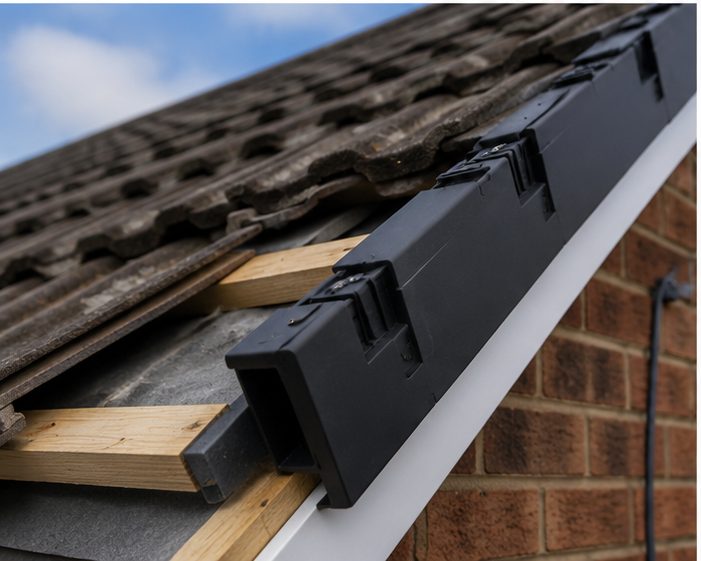
How gaps form at a verge
Mortar is not flexible. Frost, wind and the slow movement of the roof crack it, and bits start to drop. Once the bedding loosens, the underside of the tile ends is exposed. Sparrows, starlings and other birds are quick to nest in such gaps, and wasps and bees will happily use the dry shelter. Garages and porch roofs are included.
What a dry verge changes
The units are mechanically fixed to the roof and close the tile ends neatly. Cap pieces seal the open ends of the tile courses. With no wet mortar there is nothing to shrink and crack, so the edge stays closed in the way it was fitted. Weather is kept out at the same time as wildlife. The result is a tidy, closed edge.
- Verge units hold the edge in place.
- Cap and tile-end pieces close the open ends.
- No mortar bedding to open up over time.
- Rain and wind find fewer ways in.
Gabled and hipped roofs
Many houses here are hipped, with fewer verges than a gabled house, but garages, porches and some extensions still carry them. Each verge is a potential gap. Hips and ridges are a different detail, so we look at them separately. We check each edge of the roof rather than assuming one fix suits them all. Hips and ridges are looked at separately.
If something is already living there
If a nest or insects are already in the roof space, closing the edge is not the first step. Nesting birds are protected, so we do not disturb an active nest, and an insect nest needs a pest professional. We advise on timing, then close the edge once it is safe and appropriate to do so. Safety for both the wildlife and our crew comes first.
Signs from the ground
From the path or drive, look for fallen mortar, birds coming and going at the roof edge or a ragged line along the gable. Do not go up to check. If you see these signs, call us for a proper look and we will say whether the verge needs repairing, and whether a dry verge suits your tiles.
- Mortar crumbs on the drive or path.
- Birds entering at the roof edge.
- Wasps or bees near the gable.
- Ragged or uneven line along the verge.
Frequently Asked Questions
Is a dry verge bird-proof?
It removes the open gaps at the edge that birds use, so nesting there becomes much harder. Other parts of the roof, like the eaves, are separate and we check them when advising. We check the eaves and ridge at the same visit.
Does closing the edge harm the roof space?
No. Roofs breathe through eaves and ridge ventilation, not through gaps at the verge. A closed edge keeps weather out while airflow is handled in the proper places. Ventilation stays in the right places.
Will you remove a bird nest before work?
Active nests of wild birds are protected, so we do not disturb them. We plan timing around the nest and close the edge once it is no longer in use. We explain how that affects the schedule.
Talk to our team about dry verge systems in Bishopsworth
Every roof is different — the fastest way to get an accurate answer is a quick chat with our team.