
Replacing a garage roof means stripping the old covering, checking and repairing the deck, setting correct falls and fitting a new system with proper edges and upstands.
Garages in Downend range from original inter-war additions to later extensions, and many have flat roofs that have had a hard life. Replacing one is a contained job, but it is not simply a new sheet over the top. The order of the work, and the details at the edges, decide how well it lasts.
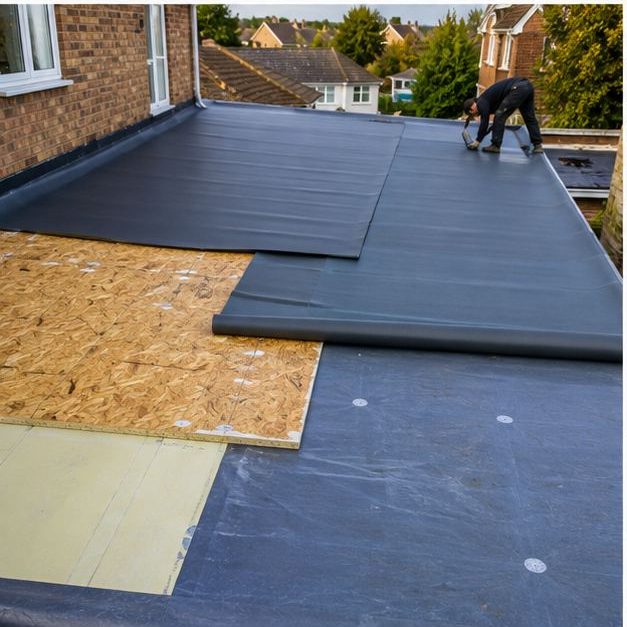
Deciding repair or replacement
First we look at what has failed. Split seams, lifted edges and a patch of ponding may be repairable. Widespread cracking, damp ceilings in the garage and soft areas underfoot suggest the roof as a whole has reached the end. We explain what we see and whether replacement is the honest answer. Inter-war garages in particular often have original decks that need more attention than later additions.
Stripping and inspecting the deck
The old covering is taken off down to the deck, which is the point where hidden problems come to light. Damp, soft or rotten boards are cut out and renewed, and the timbers beneath checked. Laying a new covering over a poor deck would only repeat the failure, so this stage matters more than the new membrane itself. We show you the condition of the boards before going further.
Falls, insulation and covering
Water needs a way off the roof, so we make sure the fall runs to the gutter or outlet. If the garage is heated or has a room attached, insulation goes in at this stage. The covering is then laid in the agreed system, whether that is single-ply rubber, fibreglass or felt. Elements of a typical replacement: The choice of system depends on the shape of the roof and how it is reached.
- Old covering stripped and removed from the deck
- Deck repaired or renewed where needed
- Falls checked and corrected towards the outlet
- Insulation fitted if the garage needs it
- New covering laid in the agreed system
Edges, upstands and outlets
The details finish the roof. We form upstands where it meets a house or garage wall, fit edge trims so water falls cleanly into the gutter and seal around pipes, outlets and any rooflights. Gutters are checked and refitted if needed. Most garage roof failures begin at these details, not the middle of the roof. Where the garage meets a house wall, the junction is checked with extra care.
Before you agree anything
Ask for a written description that says how the deck will be dealt with, what the system is and how the edges are finished. Replacing a flat roof may need planning or Building Regulations checks — we advise before work starts. Call us for a proper look at your garage. We also say what is outside the job, so there are no surprises.
Frequently Asked Questions
Do I need to empty the garage?
Usually not entirely, but it helps to move anything valuable or sensitive away from the walls and clear the floor. Work happens on top, though we may need access to check the underside of the deck. Cars and tools are best kept clear of the walls.
Will the new roof leak at the wall?
Not if the junction is done properly. A correctly formed upstand with a flashing or sealed finish at the wall is one of the most important details, and we pay particular attention to it. Details at the wall matter more than the middle of the roof.
Which covering is best for a garage?
It depends on the shape of the roof, access and what you want from it. Single-ply rubber, fibreglass and felt systems each have uses. We explain the differences and suit the system to your garage.
Talk to our team about flat roofing in Downend
Every roof is different — the fastest way to get an accurate answer is a quick chat with our team.