
A vented soffit lets fresh air into the roof space at the eaves. That airflow carries moisture away, which matters most in homes with added insulation or converted lofts.
Soffit vents are easy to overlook. They sit under the eaves, small and quiet, and they do a steady job: letting air in so damp air can leave. In Downend, where so many houses have extra insulation, converted lofts or extensions, getting that airflow right is part of keeping the roof structure in good health. Done right, it quietly protects the whole structure.
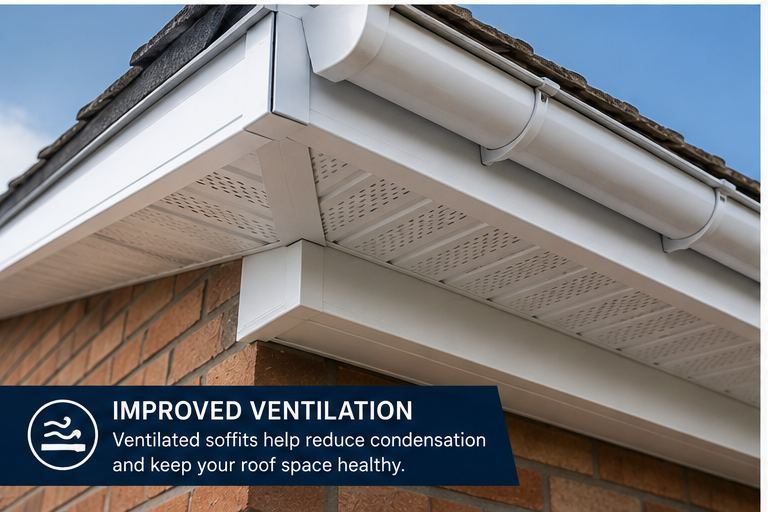
What the vents actually do
Air comes in through the soffit, passes up under the roof covering and leaves near the ridge or through other high vents. That movement stops warm, moist air from the house settling on cold timber and felt. Without it, moisture builds up quietly, and the first sign is often a musty loft or spotted rafters, not any visible leak. It is a slow process that rarely shouts about itself.
Why altered homes are more at risk
Loft conversions and extra insulation change how a roof space works. Insulation pushed into the eaves can block the path air needs, and a converted loft room produces its own moisture. Older homes with closed boards at the eaves may never have had vents. Putting these right is the time to improve how the roof breathes. Many such changes were made without thought to the eaves.
Different houses, different answers
Terraces, semis and later estates do not all need the same arrangement. Some have deep eaves where full vented soffit boards fit well. Others suit a slim vent strip behind the fascia. The choice follows the eaves detail, the roof pitch and what is already above. The approach is checked house by house rather than copied from the last job. We look at each house on its own merits.
What happens when we replace soffits
We remove the old boards and gutters, check rafter ends and eaves, and fit new boards with vents or vent strips. Gutters are refitted or replaced. Scaffold or safe access is arranged first. On older homes we check what existing soffit boards are made of before disturbing them. Things to ask any installer:
- How ventilation will be provided at the eaves
- Whether insulation will be kept clear of the vents
- How the rafter ends will be checked
- How access will be arranged
Signs it may not be breathing
From inside, look for condensation on the loft hatch, a damp smell, mould in top-floor corners or frosty-looking felt in cold weather. From outside, solid soffits with no vents are a clue. None of this proves a fault, but it is a good reason to call us for a proper look. Loft hatches are a good place to feel for a stale, cold air smell.
Frequently Asked Questions
Do vents let rain or birds in?
Properly made soffit vents and vent strips have small openings that allow air through while keeping birds and insects out, and rain does not blow upwards into them. We choose a type to suit the eaves. Birds and insects stay out; air gets in.
Do I need vents if I have no loft room?
Yes. Every pitched roof space benefits from airflow, whether or not anyone uses it. Moisture from the house still rises, and timber and felt stay healthier when the space can breathe. It is a simple precaution.
Can vents be added without replacing everything?
Sometimes vent strips or disc vents can be added to existing boards. Whether that is enough depends on the boards and the roof space. We look and advise honestly on what the roof needs. We keep it honest.
Talk to our team about UPVC fascias and soffits in Downend
Every roof is different — the fastest way to get an accurate answer is a quick chat with our team.