
A new flat garage roof is a series of steps, each of which affects how long the result lasts. Here is what the job involves on a Nailsea garage, from the first look to the final edge trims.
Garages on Nailsea's estates often carry the same flat roof they were built with, and years of open weather take their toll. Replacing it is straightforward in outline: strip, check, rebuild and seal. The detail inside each step is what decides whether the new roof does its job and keeps the garage dry.
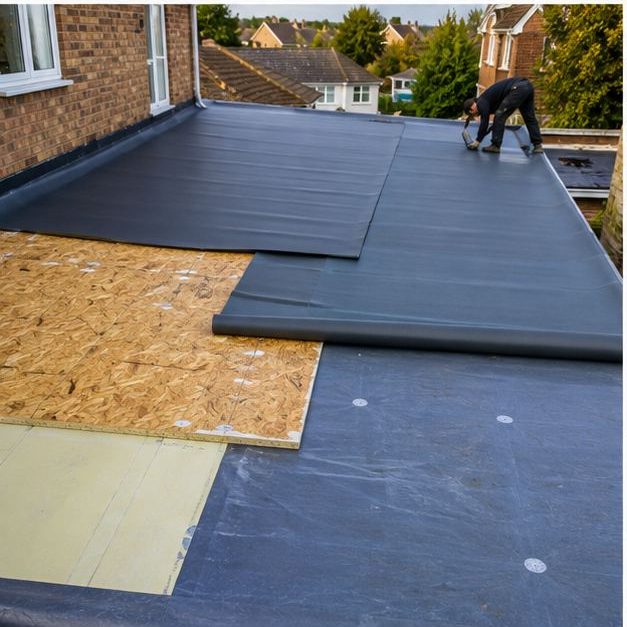
What we look at first
We inspect the roof from outside and the underside from inside the garage. We look for stains and daylight, soft boards, ponding and how the covering has aged. We also check the walls and the fascia or gutter edge. This tells us whether the roof can be re-covered, needs a partial rebuild or needs a complete new deck.
We also ask how the garage is used, since a workshop, a store and a car-only space can call for different details. A workshop may want insulation and a drier deck, while a simple store may not, and the roof is built to suit that use rather than to a fixed pattern.
Taking off the old covering
The existing covering is stripped back to the deck. Nothing is hidden at this stage, and any rot, wet boards or damage is visible. If boards are soft or stained, they are cut out and replaced with new timber, as covering over damaged boards simply seals the problem in. We show you what has been found before moving on.
- Old layers removed back to the bare deck
- Rotten or damp boards cut out and renewed
- Deck fixings checked and surface made smooth
- Dust and debris cleared before anything is laid
Falls, insulation and the finished surface
A new roof needs a proper fall, so water runs off to the gutter or outlet. We correct the slope where we can using firring pieces, and add insulation if the garage is used for more than storage. The covering, whether single-ply rubber, fibreglass or a felt system, is then laid and sealed at joins, corners and penetrations such as vents.
Edges and weather exposure
Because Nailsea can be exposed to westerly wind and rain, the edges matter. We fit firm edge trims, make sure the covering is held down properly at the perimeter and form neat upstands against the house wall. The gutter or outlet is checked so water leaves cleanly. Where the work changes the structure of the garage, it may need planning or Building Regulations checks, and we advise before work starts.
Finishing and care
When the job is done, the site is cleared, and we talk you through what has been done. Keep outlets and gutters clear, and have the roof looked at after severe weather. Weather decides the pace of the work, as the deck must be dry before the covering goes on, so we agree a sensible plan with you in advance.
Frequently Asked Questions
Can the new covering go over the old?
Only where the existing roof is dry, firm and flat. If the old layers are wet, loose or blistered, they come off first, otherwise the same problem comes back under the new covering.
Which material is best for a garage?
It depends on the shape, the use and the details. Single-ply rubber, fibreglass and felt systems all suit different roofs. We explain the options for your garage and what each involves. We talk it through.
Will the garage need to be emptied?
Usually not, but it helps to clear space beneath so nothing is damaged by falling debris. Removing valuables from shelves under the roof is sensible, and we will tell you if more is needed. Tell us about anything fragile.
Talk to our team about flat roofing in Nailsea
Every roof is different — the fastest way to get an accurate answer is a quick chat with our team.